Kilimanjaro New Moon Climbs 2027
Dates, stargazing and what to expect

by The Adventure People on 28th October 2026
Would you like to write for our blog? Please send an email to hello@theadventurepeople.com we'd love to hear your ideas!
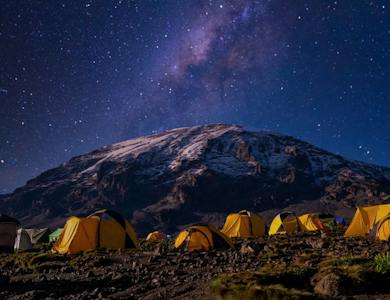
Most climbers who time their Kilimanjaro trip by the moon chase the full moon. But summit night on a new moon has a magic of its own: with no moonlight at all, the sky above Africa's highest mountain fills with more stars than most people will ever see.
You're climbing above most of the atmosphere's haze, far from any big city lights, so the Milky Way can stretch across the sky like a band of glowing cloud. Below you'll find the 2027 new moon dates in Tanzania, what a dark summit night is really like, tips for stargazing and night photography, and how a new moon climb compares with a full moon one.
Kilimanjaro new moon dates 2027 at a glance
There are 13 new moons in 2027, with two in August. All times below are East Africa Time (UTC+3), the local time on Kilimanjaro.
The last column shows roughly when the brightest part of the Milky Way, its glowing centre, is above the horizon during summit night (midnight to dawn). Even when it isn't, a moonless sky is still packed with stars.
Month | New moon (Tanzania time) | Season on Kilimanjaro | Milky Way centre on summit night (approx.) |
|---|---|---|---|
January | 7 January, 23:25 | Short dry season | Below the horizon |
February | 6 February, 18:57 | Short dry season | Rises low in the east just before dawn |
March | 8 March, 12:31 | Long rains begin | Rises in the early hours |
April | 7 April, 02:53 | Long rains | Up for most of the climb |
May | 6 May, 14:00 | Long rains | Up all night, high overhead |
June | 4 June, 22:41 | Long dry season | Up all night, high overhead |
July | 4 July, 06:03 | Long dry season | Up for most of the climb, setting before dawn |
August | 2 August, 13:06 | Long dry season | Up for the first half of the climb |
August | 31 August, 20:42 | Long dry season | Sets around the start of the climb |
September | 30 September, 05:36 | Long dry season | Below the horizon |
October | 29 October, 16:36 | Short rains approaching | Below the horizon |
November | 28 November, 06:25 | Short rains | Below the horizon |
December | 27 December, 23:13 | Short rains easing | Below the horizon |
May 2027 is a rare bonus. The new moon on 6 May coincides with the peak of the Eta Aquariid meteor shower, one of the best showers for the southern hemisphere and the tropics. Its meteors are best seen in the hours before dawn, exactly when you're climbing, with good rates for about a week around the peak.
Our 2027 new moon departures
"Summit night" shows when your summit climb falls compared with the new moon. Every one of these gives you a moonless sky for all or almost all of the climb, and the section on what to expect explains how each one differs.
New moon | Route | Departure date | Summit night | Book |
|---|---|---|---|---|
7 January | Lemosho | 2 January 2027 | 1 night after | |
7 January | Machame, 8 days | 2 January 2027 | 1 night before | |
7 January | Machame, 7 days | 2 January 2027 | 1 night before | |
7 January | Marangu | 3 January 2027 | 1 night before | |
7 January | Rongai | 3 January 2027 | New moon night | |
6 February | Lemosho | 30 January 2027 | 1 night before | |
6 February | Rongai | 31 January 2027 | 2 nights before | |
8 March | Machame, 8 days | 6 March 2027 | 2 nights after | |
8 March | Machame, 7 days | 6 March 2027 | 2 nights after | |
8 March | Marangu | 7 March 2027 | 2 nights after | |
7 April | Lemosho | 3 April 2027 | 2 nights after | |
7 April | Machame, 8 days | 3 April 2027 | New moon night | |
7 April | Machame, 7 days | 3 April 2027 | New moon night | |
7 April | Marangu | 4 April 2027 | New moon night | |
7 April | Rongai | 4 April 2027 | 1 night after | |
6 May | Lemosho | 1 May 2027 | 1 night after | |
6 May | Machame, 8 days | 1 May 2027 | 1 night before | |
6 May | Machame, 7 days | 1 May 2027 | 1 night before | |
6 May | Marangu | 2 May 2027 | 1 night before | |
6 May | Rongai | 2 May 2027 | New moon night | |
4 June | Lemosho | 29 May 2027 | New moon night | |
4 June | Machame, 8 days | 29 May 2027 | 2 nights before | |
4 June | Machame, 7 days | 29 May 2027 | 2 nights before | |
4 June | Marangu | 30 May 2027 | 2 nights before | |
4 June | Rongai | 30 May 2027 | 1 night before | |
4 July | Lemosho | 26 June 2027 | 2 nights before | |
2 August | Machame, 8 days | 31 July 2027 | 2 nights after | |
2 August | Machame, 7 days | 31 July 2027 | 2 nights after | |
2 August | Marangu | 1 August 2027 | 2 nights after | |
31 August | Machame, 8 days | 28 August 2027 | 1 night after | |
31 August | Machame, 7 days | 28 August 2027 | 1 night after | |
31 August | Marangu | 29 August 2027 | 2 nights after | |
31 August | Rongai | 29 August 2027 | 2 nights after | |
30 September | Lemosho | 25 September 2027 | 1 night after | |
30 September | Machame, 8 days | 25 September 2027 | 1 night before | |
30 September | Machame, 7 days | 25 September 2027 | 1 night before | |
30 September | Marangu | 26 September 2027 | 1 night before | |
30 September | Rongai | 26 September 2027 | New moon night | |
29 October | Lemosho | 23 October 2027 | New moon night | |
29 October | Machame, 8 days | 23 October 2027 | 2 nights before | |
29 October | Machame, 7 days | 23 October 2027 | 2 nights before | |
29 October | Marangu | 24 October 2027 | 2 nights before | |
29 October | Rongai | 24 October 2027 | 1 night before | |
28 November | Lemosho | 20 November 2027 | 2 nights before | |
27 December | Machame, 8 days | 25 December 2027 | 2 nights after | |
27 December | Machame, 7 days | 25 December 2027 | 2 nights after | |
27 December | Marangu | 26 December 2027 | 2 nights after |
What to expect on a new moon summit night
With no moon, summit night is a night of two worlds: the small pool of light from your headtorch at your feet, and an enormous sky above. Here's how a typical night unfolds from high camp, at around 4,700m.
- Around 23:00, wake-up. Step out of your tent and look up before you switch on your headtorch. After a few minutes, your eyes adjust and the sky seems to fill with more stars by the second.
- Around midnight, set off. The group climbs in a slow line of headtorches, each lighting only a few metres of trail. The slope above is invisible except for the torches of groups ahead, which look like a string of stars climbing the mountain.
- Midnight to 05:00, the long climb. This is the steepest, coldest stretch. Your world shrinks to the next step, the boots in front and the stars overhead. During short rests, switch off your headtorch for a moment and take in the sky.
- Around 05:00, the first glow. A faint band of light creeps along the eastern horizon behind Mawenzi. After hours of darkness, it's a huge lift.
- Around 05:30 to 06:30, the crater rim. You reach Stella Point or Gilman's Point as the sky turns from deep blue to orange. With no moon competing, sunrise feels all the more dramatic.
- Sunrise to mid-morning, Uhuru Peak and descent. The last stretch along the rim leads to the summit at 5,895m, then you head back down for rest and food.
Before or after the new moon: what changes
You don't need to summit on the exact night of the new moon. For a few nights either side, the moon is no more than a thin crescent, and it's in the sky at the wrong time of day to brighten a midnight climb. Here's how it will look around the October 2027 new moon to serve as a guide, using the predicted moonrise and moonset times at the foot of the mountain.
Summit night | How lit | The moon during your climb |
|---|---|---|
2 nights before | About 1% | A hair-thin crescent rises around 05:00, just before dawn; too faint to light anything |
1 night before | Under 1% | Rises around 05:50, as the sky is already brightening |
New moon night | 0% | No moon at all |
1 night after | About 1% | Set around 19:15 the evening before; dark all night |
2 nights after | About 5% | Set around 20:10 the evening before; dark all night |
The nights after the new moon are the darkest choice for a summit climb: the young crescent sets in the early evening, hours before you leave camp. On the nights before, a thin crescent appears just before dawn. Far from spoiling the view, it can be beautiful, sometimes with the rest of the moon's disc faintly lit by sunlight reflected off Earth. The exact times shift a little each month, but the pattern is the same all year.
Benefits and disadvantages of a new moon climb
The benefits
A sky full of stars. With no moonlight, you'll see stars down to the faintest your eyes can manage. The Milky Way, the Southern Cross and, at some times of year, the Magellanic Clouds (two small neighbouring galaxies) all stand out.
Dark nights at every camp, not just summit night. A climb timed around the new moon means darker skies for several nights in a row. That gives you relaxed evenings to stargaze from camp, when you're not tired or on the move.
Shooting stars and satellites. Without moonlight, faint meteors and passing satellites are far easier to spot. In May 2027, the Eta Aquariid meteor shower adds to the show.
A sunrise that feels earned. After hours of total darkness, the first glow on the horizon and the sunrise from the crater rim feel even more dramatic.
Fewer climbers chasing the same dates. Full moon dates are the ones most climbers chase, so new moon departures are less in demand. That can mean more choice of dates.
The disadvantages
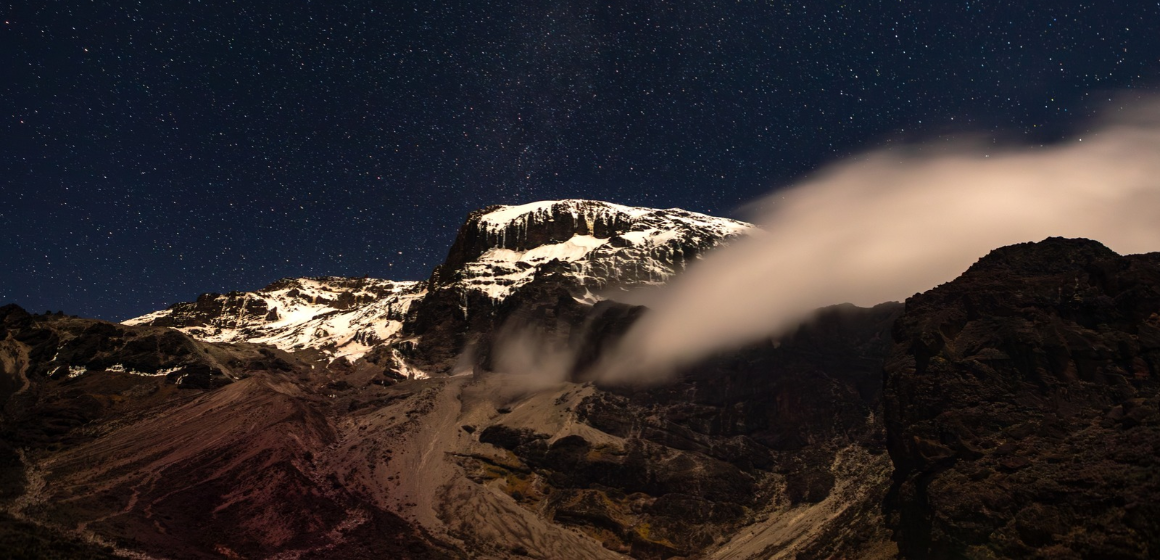
You only see what your headtorch shows you. The scree slopes, glaciers and cloud sea stay hidden until dawn. Some climbers find this makes the night feel longer.
More reliance on your torch. A weak or failing headtorch matters more when there's no moonlight to fall back on, so spare batteries are essential.
It can feel disorientating. With no view of the slope ahead, it's harder to judge how far you've come. Trust your guides' pacing, and treat each rest as a chance to look up.
Cloud is still a factor. A new moon guarantees darkness, not a clear sky. As with any climb, the dry seasons give you the best odds of seeing the stars.
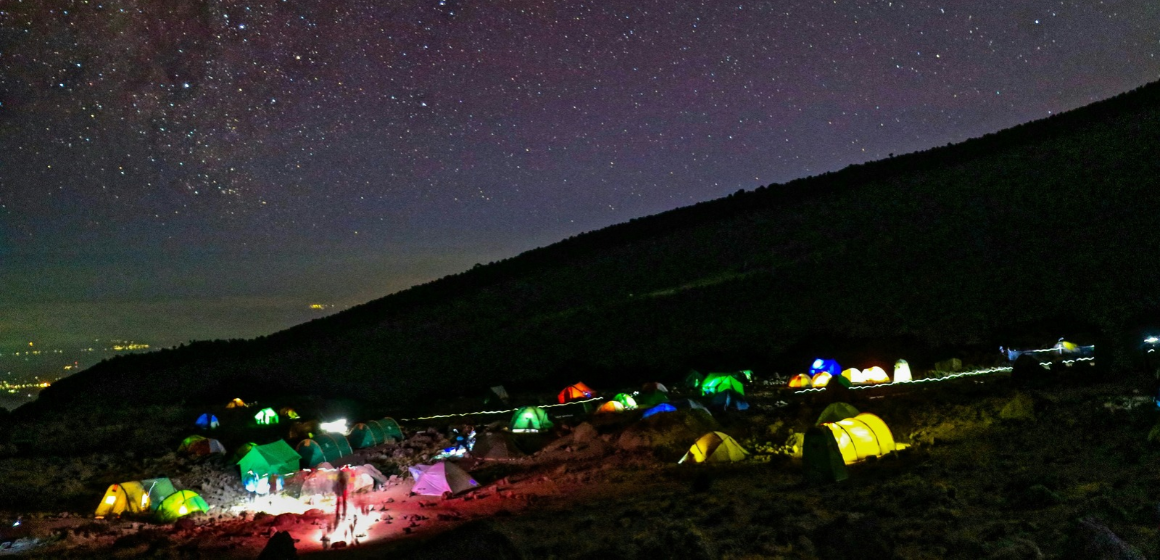 Photo by Tom Cleary on Unsplash
How to make the most of the stars
The best stargazing usually happens at camp on the nights before summit night, not on the climb itself. On summit night you'll be moving in a line with your group, so save the long looks and the photos for the evenings when you're rested.
Stargazing tips
- Give your eyes time. It takes around 20 to 30 minutes in full darkness for your eyes to adapt. One glance at a bright screen or white torch resets the clock.
- Use red light. Switch your headtorch to its red mode around camp. It's kinder to your night vision and to everyone else's.
- Download a star app before you go. There's little or no signal on much of the mountain, so pick an app that works offline. Hold it up to the sky to name stars, planets and constellations.
- Know what to look for. Look for the Milky Way, the Southern Cross low in the south, and any bright planets. Between roughly April and July, the glowing centre of the Milky Way sits high overhead in the early hours.
- Get comfortable and wrap up. Lie back on a sit mat in your down jacket and hat, so you can watch for longer. Nights at high camp are well below freezing.
- Stay close to camp. Stargaze within sight of your tents, and let your guide know if you're heading out after dark.
Night photography tips
With a phone:
- Use night mode, and keep the phone completely still for the whole exposure. A mini tripod or a flat rock works better than your hands.
- Tap to focus on a bright star, and turn the screen brightness down so it doesn't ruin your night vision.
- Try a glowing tent: ask a tentmate to switch a headtorch on low inside the tent while you shoot it against the stars.
With a camera:
- Use your widest lens at its widest aperture, ideally f/2.8 or faster, on a lightweight tripod.
- Start with ISO 3200 to 6400 and an exposure of 15 to 20 seconds. Much longer and the stars start to trail.
- Focus manually: zoom in on a bright star on your screen and adjust until it's a sharp point.
- Use a two-second timer or a remote so pressing the button doesn't shake the camera, and shoot in RAW for more editing flexibility.
- Include a foreground, such as tents, a lobelia plant or the outline of Mawenzi, to give a sense of place.
Protect your kit from the cold. Cold drains batteries fast, so keep spares in an inside pocket. When you bring a cold camera into a warm tent, seal it in a bag first so condensation forms on the bag, not inside the lens.
New moon vs full moon: which should you choose?
Choose a full moon if you want to see the mountain on summit night. Choose a new moon if you want to see the universe. Here's how the two compare.
New moon climb | Full moon climb | |
|---|---|---|
Night sky | Thousands of stars, the Milky Way and shooting stars | Bright moon; only the brightest stars visible |
Landscape at night | Hidden until dawn | Glaciers, scree slopes and cloud sea lit silver |
Trail on summit night | Headtorch only | Headtorch still needed for footing, but you can see the slope ahead |
Summit sunrise | Extra dramatic after total darkness | Moon sets in the west as the sun rises in the east |
Best photos | Star trails, the Milky Way and glowing tents | Moonlit glaciers and night landscapes |
Evenings at camp | Several dark nights in a row for stargazing | Bright, moonlit camps |
Demand | Less sought after | The most popular dates to climb |
Best for | Stargazers, night photographers and anyone who loves a dark sky | Climbers who want to see where they are on summit night |
Whichever you choose, the season matters more than the moon. A clear dry-season night will beat a cloudy rainy-season night, new moon or full. Read our guide to climbing Kilimanjaro under a full moon, or our month-by-month guide to the best time to climb.
Frequently asked questions
When is the new moon on Kilimanjaro in 2027?
The 2027 new moons in Tanzania fall on 7 January, 6 February, 8 March, 7 April, 6 May, 4 June, 4 July, 2 August, 31 August, 30 September, 29 October, 28 November and 27 December. See the calendar above for exact local times.
Is a new moon a good time to climb Kilimanjaro?
Yes, if you love the night sky. You'll see far more stars than on a moonlit night, and you'll have several dark evenings at camp to enjoy them. The trade-off is that the landscape stays hidden until dawn on summit night.
Do I need to summit on the exact night of the new moon?
No. For two or three nights either side, the moon is a thin crescent that's either set before you start or only rises around dawn. The nights just after the new moon are the darkest of all for a midnight climb.
Is it harder to climb Kilimanjaro on a new moon?
The climb itself is the same: same altitude, same cold, same trail. It can feel more disorientating in the dark, as you can't see the slope ahead, but a good headtorch and your guides' steady pace make it very manageable.
When is the best time to see the Milky Way from Kilimanjaro?
The brightest part of the Milky Way is best seen from around April to July, when it's high in the sky during the early hours. From May to early August, it's also up in the evenings at camp.
Can I see shooting stars on Kilimanjaro?
Yes, on most clear, dark nights. In 2027, the Eta Aquariid meteor shower peaks on 6 May, the same day as the new moon, with good rates in the pre-dawn hours for about a week either side.
Should I bring a camera for night photography?
A phone with a night mode and a mini tripod is enough for good results. If you're keen on astrophotography, a camera with a wide, fast lens and a lightweight tripod will give you far more, but remember you'll be carrying it in your daypack.
Ready to book your Kilimanjaro climb?
Check out our full range of Kilimanjaro treks and book your preferred departure.
Further Reading
Continue your preparation for Kilimanjaro with these handy articles on our website: