Kilimanjaro Full Moon Climbs 2027: dates and what to expect
With departures that line up with the full moons

by The Adventure People on 28th October 2026
Would you like to write for our blog? Please send an email to hello@theadventurepeople.com we'd love to hear your ideas!
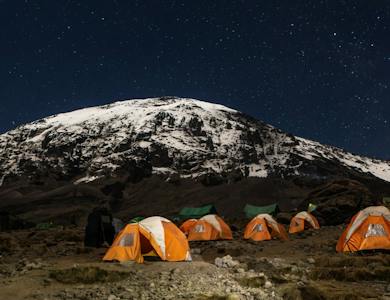
The final push to Uhuru Peak starts around midnight, so most of the hardest climbing on Kilimanjaro happens in the dark. Time your trip so that summit night falls on or close to a full moon, and that darkness turns silver: the scree slopes, the glaciers and the cloud sea far below are lit up as you climb.
Below you'll find the 2027 full moon dates and times in Tanzania, the departures of ours that line up with them, and an honest look at what a moonlit summit night is like, including what the moon can't change.
Kilimanjaro full moon dates 2027 at a glance
In 2027 we have full moon departures in eight months, across the Lemosho, Machame, Marangu and Rongai routes. All times below are East Africa Time (UTC+3), the local time on Kilimanjaro.
Full moon calendar 2027
Month | Full moon (Tanzania time) | Season on Kilimanjaro | Full moon departures |
|---|---|---|---|
January | 22 January, 15:17 | Short dry season | Yes |
February | 21 February, 02:24 | Short dry season | No |
March | 22 March, 13:44 | Long rains begin | No |
April | 21 April, 01:27 | Long rains | Yes |
May | 20 May, 13:59 | Long rains | Yes |
June | 19 June, 03:45 | Long dry season | Yes |
July | 18 July, 18:46 | Long dry season | No |
August | 17 August, 10:30 | Long dry season | Yes |
September | 16 September, 02:05 | Long dry season | Yes |
October | 15 October, 16:45 | Dry, short rains approaching | Yes |
November | 14 November, 06:27 | Short rains | No |
December | 13 December, 19:10 | Short rains easing | Yes |
The February full moon is the standout of the year: it peaks in the middle of summit night itself, in one of the clearest months to climb. A subtle penumbral lunar eclipse also takes place that night, though it only dims the moon slightly. We don't have a group departure that lines up with it, but if you're travelling with a small group, we can arrange a private departure timed for the February full moon.
Our 2027 full moon departures
"Summit night" shows when your summit climb falls compared with the full moon. Every one of these gives you moonlight for all or almost all of the climb, and the section on what to expect explains how each one differs.
Month | Route | Departure date | Summit night | Book |
|---|---|---|---|---|
January | Lemosho | 16 January 2027 | Full moon night | |
January | Rongai | 17 January 2027 | 1 night before | |
April | Machame, 8 days | 17 April 2027 | Full moon night | |
April | Machame, 7 days | 17 April 2027 | Full moon night | |
April | Marangu | 18 April 2027 | Full moon night | |
April | Rongai | 18 April 2027 | 1 night after | |
May | Lemosho | 15 May 2027 | 1 night after | |
May | Machame, 8 days | 15 May 2027 | 1 night before | |
May | Machame, 7 days | 15 May 2027 | 1 night before | |
May | Marangu | 16 May 2027 | 1 night before | |
May | Rongai | 16 May 2027 | Full moon night | |
June | Lemosho | 12 June 2027 | 1 night before | |
August | Machame, 8 days | 14 August 2027 | 1 night after | |
August | Machame, 7 days | 14 August 2027 | 1 night after | |
August | Marangu | 15 August 2027 | 1 night after | |
August | Rongai | 15 August 2027 | 2 nights after | |
September | Lemosho | 11 September 2027 | 1 night after | |
September | Machame, 8 days | 11 September 2027 | 1 night before | |
September | Machame, 7 days | 11 September 2027 | 1 night before | |
September | Marangu | 12 September 2027 | 1 night before | |
September | Rongai | 12 September 2027 | Full moon night | |
October | Lemosho | 9 October 2027 | Full moon night | |
October | Rongai | 10 October 2027 | 1 night before | |
December | Machame, 8 days | 11 December 2027 | 2 nights after | |
December | Machame, 7 days | 11 December 2027 | 2 nights after | |
December | Marangu | 12 December 2027 | 2 nights after |
Why climb Kilimanjaro under a full moon?
A full moon doesn't make the climb any shorter or the air any thicker, but it changes how summit night feels. On a clear night, these are the moments climbers talk about afterwards.
You can see where you are. On a dark night, your world shrinks to the circle of your headtorch and the boots in front of you. Under a full moon you can see the zigzag of the trail above, the line of headtorches stretching up the slope and the crater rim you're aiming for.
The mountain lights up. Moonlight catches the glaciers and the snow near Stella Point, and the cloud below the mountain glows pale silver. Mawenzi, Kilimanjaro's jagged second peak, stands out sharply to the east.
It can lift your spirits. Summit night is long, cold and tiring, and the hours before dawn are often the hardest. Seeing the landscape around you, rather than just darkness, gives your mind something to hold on to.
Moonset and sunrise together. On or just after the full moon, the moon sinks in the west as the sun rises in the east. If you reach the crater rim around dawn, you may see both at once.
Brilliant photos. Moonlit glaciers and a sky still bright enough to show the summit sign make for photos you won't get on a darker night. A phone with a night mode will handle it, but a steady hand helps.
"Climbing Kilimanjaro during a full moon is a special experience. When the summit attempt coincides with a full moon, the moonlight illuminates the mountain, glaciers, and surrounding landscape, creating a magical atmosphere during the night ascent." − Dismas Mtui, local guide with 11 years' experience trekking Kilimanjaro
What to expect on a full moon summit night
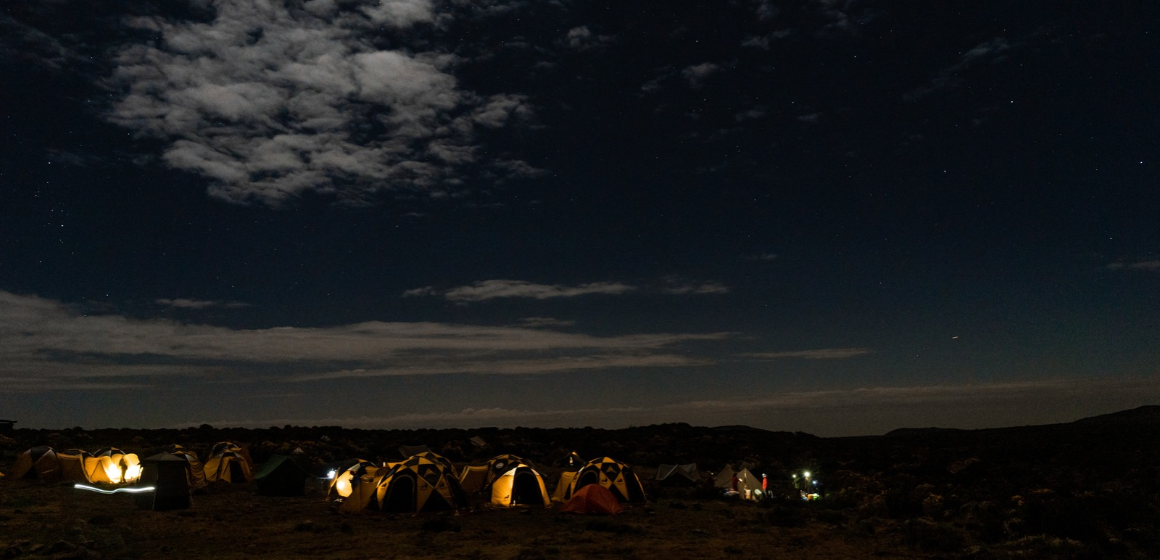
Apart from the light, a full moon summit night runs just like any other. Here's how a typical night unfolds from high camp, at around 4,700m.
- Around 23:00, wake-up. Your guides wake you with hot tea and a light snack. Outside, the moon is already well up, having risen around sunset.
- Around midnight, set off. You leave camp in a slow, steady line. The full moon is close to its highest point, so the slope ahead is at its brightest.
- Midnight to 05:00, the long climb. This is the steepest and coldest stretch, on loose scree and switchbacks. Even in bright moonlight, keep your headtorch on for your footing.
- Around 05:30 to 06:30, the crater rim. You reach Stella Point or Gilman's Point as the sky lightens. The moon is now low in the west, and the first glow of sunrise spreads in the east.
- Sunrise to mid-morning, Uhuru Peak. The last hour along the crater rim takes you past the glaciers to the summit at 5,895m, usually in full daylight.
- Descent. You head back down to high camp for rest and food, then continue to a lower camp for the night.
Before or after the full moon: what changes
You don't need to summit on the exact night of the full moon. For a few nights either side, the moon is still 95% lit or more and looks full to the eye. What changes from night to night is when it rises and sets: each night it comes up roughly 45 minutes to an hour later than the night before.
Here's how it will look around the October 2027 full moon, using the predicted moonrise and moonset times at the foot of the mountain.
Summit night | How full | Moonrise (evening) | Moonset (next morning) | What it means on the climb |
|---|---|---|---|---|
1 night before | 99% | 17:26 | 05:40 | Up from sunset; sets in the west shortly before dawn, as you near the crater rim |
Full moon night | 100% | 18:11 | 06:26 | Up all night; sets around sunrise, so you may see moonset and sunrise together |
1 night after | 98% | 19:00 | 07:14 | Rises an hour after dark and stays up past sunrise |
2 nights after | 95% | 19:52 | 08:07 | Rises around two hours after dark, still well before a midnight start; up for the whole climb |
- 1 night before: moonlight for almost the whole climb. The moon dips below the horizon a little before dawn, but by then the sky is starting to lighten.
- Full moon night: the brightest, longest moonlight, from your wake-up call to sunrise.
- 1 or 2 nights after: the moon is already high when you set off and still in the sky as the sun comes up. To the eye it looks just as full, and it lights the whole climb.
The exact times shift a little each month, but the pattern is the same all year.
Weather and other limitations
The date of the full moon is fixed, but the weather on summit night isn't. Here's what the moon can't promise.
Cloud can hide it. The moon is only as good as the sky in front of it. Your best odds of a clear summit night are in the dry seasons: January and February, and June to early October. In the dry season, research on the summit glaciers has found that cloud often builds below the summit plateau and then breaks up, so you can climb out above it into clear air.
Rainy-season full moons are a gamble. Our April and May departures fall in the long rains, when cloud, rain and summit snow are more likely. In return, trails are at their quietest. Choose these dates for the solitude, and treat a moonlit summit as a bonus.
December falls at the end of the short rains. Our December departures summit in mid-December, when afternoon showers are still possible but usually easing, with clear mornings in between.
Fewer stars. A bright moon washes out the Milky Way, which is spectacular from Kilimanjaro on a dark night. If stargazing is your priority, a new moon is the better choice.
It's just as cold. The moon brings light, not warmth. The summit averages around −7°C in every month, and wind before dawn makes it feel much colder.
The altitude doesn't change. Moonlight doesn't make the climb easier on your body. Acclimatisation, pace and a well-chosen itinerary still matter far more than the moon.
Popular dates fill early. Full moon departures in the dry season are in demand, so the trail can be busier on these nights. Book early if a particular date matters to you.
Safety comes first. Your guides may change the timing of summit night for weather or health reasons, even if that means missing the full moon.
Choosing your full moon departure
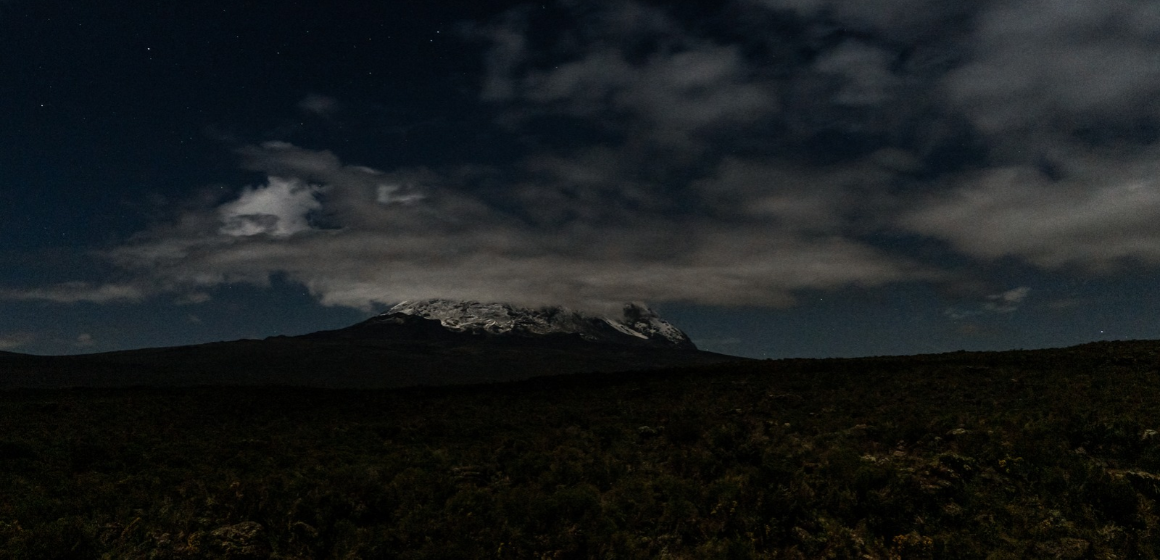
Start with the season, then the route, then the moon. A clear dry-season night one day from the full moon will beat a cloudy rainy-season night on the exact date.
- For the best chance of a moonlit summit: January, June, August, September or October, all in the dry seasons. A departure marked "1 night after" or "2 nights after" is just as good as the full moon night itself.
- For quieter trails: April, May or early December, accepting a higher chance of cloud and showers.
- For the best acclimatisation: a longer itinerary such as the Lemosho or 8-day Machame route, which gives your body more time to adjust before summit night.
- Plan your flights around the departure, not the moon. Your summit night is set by your route's itinerary, so check the departure date in the table above.
What to pack for a moonlit summit night
Pack exactly as you would for any summit night, with a few extras that make the most of the moonlight.
Item | Why it matters on a full moon night |
|---|---|
Headtorch with spare batteries | Moonlight shows the landscape, but you still need a beam for loose scree and rocks underfoot |
Headtorch with a red-light mode | Saves your night vision so you can enjoy the moonlit views between steep sections |
Phone or camera with a night mode | For moonlit glaciers and crater views; keep it in an inside pocket so the cold doesn't drain the battery |
Full summit layers | Down jacket, insulated gloves with liners, a warm hat and a buff: the moon adds no warmth |
Sunglasses in your daypack | The sun comes up fast over the crater rim, and the glare off snow and ice is intense |
Frequently asked questions
When is the full moon on Kilimanjaro in 2027?
The 2027 full moons in Tanzania fall on 22 January, 21 February, 22 March, 21 April, 20 May, 19 June, 18 July, 17 August, 16 September, 15 October, 14 November and 13 December. See the calendar above for exact local times.
Do I need to reach the summit on the exact night of the full moon?
No. For a couple of nights either side, the moon is still 95% lit or more and looks full to the eye. The night before, it sets shortly before dawn; one or two nights after, it rises later in the evening but stays up until after sunrise. All of these light almost the whole of a midnight summit climb.
Does a full moon make Kilimanjaro easier?
Not physically. The altitude, the cold and the steep scree are exactly the same. What changes is the experience: you can see the trail and the mountain around you, which many climbers find makes the long night feel shorter.
Do I still need a headtorch?
Yes. Moonlight is bright enough to see the landscape, but not the loose stones under your feet. Your guides will expect everyone to carry a headtorch with spare batteries.
What's the best month for a full moon climb?
For the best chance of a clear, moonlit summit night in 2027, choose a departure in January, June, August, September or October. These all fall in Kilimanjaro's dry seasons, when cloud is least likely to hide the moon.
Can I climb at full moon in the rainy season?
Yes, we have full moon departures in April and May. Cloud, rain and summit snow are more likely, so the moon may be hidden, but you'll share the mountain with far fewer people.
Are full moon climbs busier?
They can be, as many climbers aim for the same nights, especially in the dry season. If you have your heart set on a particular date, book early.
What if cloud hides the moon on summit night?
It happens, and no one can control the weather on the mountain. You'll still have the same expert guides, the same summit and, with luck, a sunrise above the clouds.
Ready to book your Kilimanjaro climb?
Check out our full range of Kilimanjaro treks and book your preferred departure.
Further Reading
Continue your preparation for Kilimanjaro with these handy articles on our website: