Everest Base Camp and Gokyo Lakes Trek (inc food) - 18 Days
Trip Snapshot
Genders
- Female35%
- Male65%
Average age
Start / End
- Kathmandu
- Kathmandu
Physical rating
Group size
2 - 15Meals included
46Highlights
- Seamless Arrival & Cultural Immersion in Kathmandu: Begin your journey with a personal airport transfer to your luxurious hotel, followed by an enriching guided tour of UNESCO World Heritage Sites and an immersive introduction to Nepali culture.
- Breathtaking Himalayan Flight & Trek Commencement: Experience a spectacular domestic flight to Lukla, offering unparalleled panoramic views, before commencing your inspiring trek with a gentle acclimatization walk.
- First Glimpse of Everest & Sherpa Heartlands: Witness your first awe-inspiring view of Mount Everest (weather permitting) en route to Namche Bazaar, the vibrant capital of the Sherpa community, crossing the iconic Hilary Suspension Bridge.
- Acclimatization with Panoramic Views: Enjoy a crucial acclimatization day in Namche Bazaar, including a rewarding hike to the Everest View Hotel for magnificent vistas of Everest and surrounding peaks.
- Monastery Serenity & Majestic Landscapes: Trek through stunning valleys to Tengboche, a picturesque monastery town, where you may witness serene Tibetan Buddhist rituals amidst towering peaks.
- Reaching Everest Base Camp (5,364m): Achieve the ultimate trekking dream as you stand at the foot of the world's highest mountain, immersing yourself in the awe-inspiring presence of Everest and the Khumbu Icefall.
- Unforgettable Sunrise from Kalapatthar (5,545m): Experience a truly magical sunrise from Kalapatthar, offering the most spectacular 360-degree panorama of the entire Everest range, including Everest, Pumori, and Nuptse.
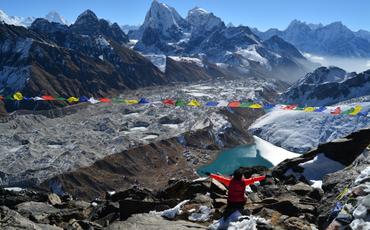
- Challenging Ascent of Chol La Pass (5,420m) & Gokyo Lakes: Conquer the exhilarating Chol La Pass, rewarded with incredible views, before descending to the stunning turquoise waters of the Gokyo Lakes.
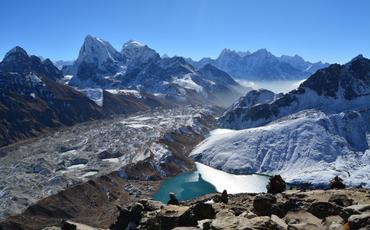
- Summiting Gokyo Ri (5,357m) for Grand Panoramas: Ascend Gokyo Ri for arguably the finest panoramic views in the Himalayas, encompassing four of the world's eight-thousander peaks: Everest, Makalu, Lhotse, and Cho Oyu. Further exploration of the 4th and 5th Gokyo Lakes is available for those with additional energy.
- Reflective Descent through Scenic Valleys: Enjoy a serene descent through picturesque landscapes, passing tranquil lakes and rhododendron forests, allowing for reflection on your extraordinary Himalayan adventure.
- Triumphant Return to Lukla & Farewell to the Himalayas: Celebrate the successful completion of your epic journey as you return to Lukla, bidding a fond farewell to the majestic Everest region.
- Concluding Your Grand Expedition: A comfortable domestic flight returns you to Kathmandu, culminating in a delightful farewell dinner and a seamless transfer for your international departure, leaving you with cherished memories of Nepal's unparalleled beauty.
Everything you need to picture the adventure and pack with confidence — in one free PDF.
What's inside the PDF
Day-by-day itinerary
Every day mapped out, covering activities, travel times, meals and where you'll stay.Packing & kit list
Exactly what to bring, from clothing and essentials to luggage guidelines and what's available to hire locally.What's included
Accommodation, transport, guides and meals, so you can see exactly what your price covers.
Summary
Tick off not one but two amazing treks in this Everest Base Camp and Gokyo Lakes Trek - 18 days! Complete the exhilarating trek and reach Everest Base Camp, and witness Mount Everest in all it's glory! You'll trek the famous trek to base camp, with many stunning stops where you'll have many viewing points as well as being surrounded by the Himalayan Beauty! You'll also get to witness the stunning beautiful of the Gokyo lakes!
Your domestic flight (Kathmandu to Lukla and back) is included in the trip cost!
Prices are based on two adults sharing. If you are a solo traveller there may be a mandatory single supplement fee.
Itinerary
Day 1
Arrival Day in Kathmandu
Welcome to Kathmandu! Upon arrival at Kathmandu Airport, a representative will be waiting for you after baggage claim and will transfer you to your hotel for the night. If you arrive with the full day ahead, make sure you make the most of the Thamel market as you can find some amazing trekking gear and accessories for your 18 day trek ahead! A pre-trip meeting may also be arranged for today, if not it will be done tomorrow with the rest of the group after sightseeing.
Lukla flights now operate from and to Manthali Airport, Ramechhap in peak hiking season. The airport lies approximately 4-5 hours drive from Kathmandu. This additional transfer will be included in the price but it is likely to involve a very early start on Day 2 - between 2 and 4am, depending on exact flight timing. This will happen during October, November, April and May.
Day 2
Kathmandu Sightseeing Day and Trek Preparation
Today after breakfast, you will join a guided tour of some of the UNESCO World Heritage Sites in Kathmandu. You'll explore Durbar Square, consisting of historic palaces built between the 12th and 18th centuries. Interesting pieces here to see are 17th century stone inscription set into the wall of the palace, Taleju temple-tallest of all structures built by king Mahendra Malla in 1549 A.D., Jagannath temple- built in the 16th century, known for fascinating erotic figures carving I the wooden struts eaves, Kal Bhairav- one of the largest stone idols in Kathmandu representing the terrorizing aspects of Shiva, Statue of King Pratap Malla in praying gesture to Digu Taleju the royal family deity right across, Kumari Ghar- 17th century Kumari temple, Kasthamandap- built from the timber of a single tree, Kathmandu derives its name from Kasthamandap. You'll continue your guided tour to many more palaces in the region and learn more about the religion and culture here in Kathmandu. After your sightseeing tour, you will have your pre-trip meeting (if not had yesterday). During the pre-trip meeting, we would introduce you to your leader/guide and other trekking group members. Please take this opportunity to ask questions you may have regarding the Everest Base Camp and Gokyo Lakes Trek or, as a whole, your questions regarding Trekking in Nepal. We will also provide you with a down jacket, Everest Base Camp trekking map, a T-shirt, and a Duffel Bag in which you can pack your things. In the evening please pack your duffel bag provided, we recommend only packing the necessary items as not to make porters carry any additional bags.
Day 3
Fly to Lukla (2,800 m/9,184 ft) and trek to Phakding (2,652 m/8,700 ft): 9km/3-4 hours trek
Today after breakfast, we will make our way to Kathmandu airport for our domestic flight to Lukla (included). This will be a 35 minutes flight roughly, but in these 35 minutes you'll be greeted with views like no other!
Please be aware that all Lukla flights in peak trekking season (Spring and Autumn) depart (and return to) from Manthali instead of Kathmandu. This is approximately 4-5 hrs drive and often involves an early start.
As we land into Lukla, we'll meet the rest of our trekking crew including porters and arrange our luggage to begin our trek. We'll only begin with a short walk to get us acclimatised, as we'll be at 3000m altitude. Then we'll trek to our teahouse for the night. All meals included.
Day 4
Phakding to Namche Bazaar (3,440 m/11,283 ft): 12km/5-6 hours
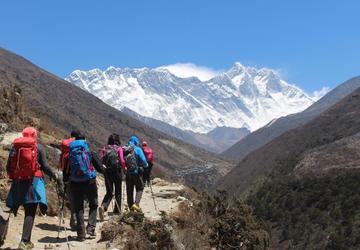
Today after breakfast, is an exciting one as we get our first glimpse of the amazing Mount Everest, weather permitting! We'll also get our permits checked at the Sagarmatha national park at Monjo. We'll then continue onto to Jorsale, then cross the famous Hilary suspension bridge before our ascend to Namche Bazaar. Namche Bazaar is the main Sherpa toen and trading station in the Khumbu Valley. All meals included.
Day 5
Acclimatization Day in Namche bazaar – Hike to Everest View Hotel: 2-4 hours acclimatisation hike
Today is our first acclimatisation day at Namche Bazaar. Today is very important, because the trek is now reaching higher altitudes so we need to have everyone accustomed to the thinning air. It is still an active day today, as we will take couple of meters hike at higher altitude a Sherpa museum, then climb to Syangboche airport, and finally stretch on to the Hotel Everest view for lunch or we return from there to our lodge for lunch. Today guarantees the best view day (weather permitting), as we see many Himalayan peaks all surrounding us from the office of Sagarmatha National park including a distant view of Everest in the backdrop. We will return to Namche Bazaar late afternoon, where you can explore the local restaurants, shops, temples and monasteries. All meals included.
Day 6
Namche Bazzar - Tengboche (3860m/12660ft): 12 kms/5-6 hrs
After ascending out of Namche Bazaar, the first 2 hours are relaxed pleasant walking, traversing the left-hand side of the valley, high above the valley base. We must take a photo break across a few small beautiful or we will miss breathtaking mountain views to record in our cameras. From every bend, we can see the outstanding view of the chain of mountains and snowcapped peaks. After crossing the suspension bridge over we come across few prayer wheels run through hydropower. Throughout the trek today we walk through the forest and can watch out for animals too. After two hours' uphill walk we reach the beautiful monastery town of Tengboche which is perched on a ridge up the river valley. After a brief rest, you can visit the monastery and attend a prayer session too. All meals included.
Day 7
Tengboche - Dingboche (4410m/14464ft): 11km/5-6 hours
Today we can wake up early to witness the Tibetan Buddhism rituals at the ancient Tengboche monastery. After this, we'll head back for breakfast and then after breakfast begin our trek for the day. We will trek downhill first to the village of Debuche until we cross Imja Khola. Then after crossing the river, our ascend to Pangboche begins. Along the way we will stop for lunch, and see The Ama Dablam's close views. After lunch we continue our walk to Dingboche. We'll start to experience the air getting thinner as we reach higher altitude. We might have headaches, nausea, loss of appetite, but we must try eating sufficient carbs and drinking at least 3 liters of water. All meals included.
Day 8
Dingboche - Acclimatization Day- Side trip to Nangkartshang Peak (5100m/16728ft)
Today is the second acclimatisation day. After enjoying breakfast with the amazing view of Ama Dablam, we hike to a ridge called Nangkartshang Peak which is behind Dingboche Village. You can hike slowly halfway up or even to the top to help with acclimatisation. The higher you go the better the views are. On the way to Nangkartshang peak, you see peak like Lobuche East peak (6119m), Lobuche West (6145m), Taboche Peak (6367m), Thamserku (6608m), Kangtega (6685m) and Ama Dablam (6856m). We can continue onwards depending on how the group is handling the altitude, and after this we'll come back to Dingboche for the night. All meals included.
Day 9
Dingboche - Lobuche (4910m/16105ft): 8.5 km/4-5 hours
We start on a gradual trail first and after an hour the path becomes steep with numerous boulders to pass. Whilst it isn’t a strenuous climb, the altitude will affect us and we will be walking very slowly.
We reach Gorekshep at lunchtime where we check in to our teahouse, have lunch and start our afternoon hike to Everest Base Camp. The trail is beautiful with giant mountains surrounding us but has plenty of rocky sections and loose stones as we walk through the moraine of Khumbu Glacier, so need to be careful. Arriving at Everest base camp is dreamlike.
You can see the Khumbu Icefall in the distance, one of the most infamous critical sections leading up to the Everest. We feel absolutely overwhelmed standing at the foot of the highest mountain in the world. But getting too excited and overexerting is not good for health at this altitude. Now again two hours' hike down to Gorekshep for overnight stay. All meals included.
Day 10
Lobuche - Everest Base Camp (5364m/17594ft) and back to Gorekshep (5181m/16994ft): 12km/8-9 hours
We start on a gradual trail first and after an hour the path becomes steep with numerous boulders to pass. Whilst it isn’t a strenuous climb, the altitude will affect us and we will be walking very slowly.
We reach Gorekshep at lunchtime where we check in to our teahouse, have lunch and start our afternoon hike to Everest Base Camp. The trail is beautiful with giant mountains surrounding us but has plenty of rocky sections and loose stones as we walk through the moraine of Khumbu Glacier, so need to be careful. Arriving at Everest base camp is dreamlike.
You can see the Khumbu Icefall in the distance, one of the most infamous critical sections leading up to the Everest. We feel absolutely overwhelmed standing at the foot of the highest mountain in the world. But getting too excited and overexerting is not good for health at this altitude. Now again two hours' hike down to Gorekshep for overnight stay. All meals included.
Day 11
Trek to Kalapatthar (5545m/18188ft) then trek to Dzongla (4,830 m/15,846 ft): 9km/6-7 hours
Today we'll wake up roughly 2 hours prior to sunrise (depending on the time of the year) and hike to Kalapatthar so we can get there just before sunrise. It is a steep trail, and roughly 1.5 hours to the top. But once you have reached the top, you'll forget all about the steep hike. You can see a 360-degree panorama of the Everest range right there in front of you, with Mount Everest itself directly in front of you and Mt. Pumori and Nuptse to your left, for a while you will feel like you are at the top of the world. After this, we walk back to Gorekshep which takes about an hour, have breakfast, and trek down to Dzongla. While we trek down the trail we get to see amazing views of Lobuche peak, Chola Tsho lake, Arakam Tse (6,423 m), Cholatse (6,335 m), and Taboche (6,367 m). Overnight at the small village of Dzongla. Tomorrow its again going to be a long day as we are going towards Gokyo. All meals included.
Day 12
Dzongla to Gokyo (4,790 m/15,715 ft) via Chola Pass (5,420m/17,780ft): 11 km/8-9 hours
We'll have an early start as we make our way to Chol La Pass, crossing before the sun hits and makes the ice along the trail melt fully which can make the trail slippery. If we maintain a steady speed, we will reach Thaknak by lunchtime, and stop here for lunch. From here's its only a 2 hour walk to Gokyo, where we will go for accommodation for the night. As we continue, the trail will get tougher compared to the EBC trail, however as we reach the top of Chola we'll be greeted with amazing views of Ama Dablam and Cholatse before descending from Chola. After this, we'll continue until we reach Gokyo for the night. All meals included.
Day 13
Full Day in Gokyo Valley: Gokyo Ri (5357 m/17,570 ft)- Optional hike to 4th and 5th Gokyo Lakes
One of the major highlights of Everest base camp and Gokyo Lakes trek si hiking over Gokyo Ri. We start our day early in expectation of amazing morning views. However, a challenging yet gratifying trek to the top of Gokyo Ri can take more than a couple of hours.
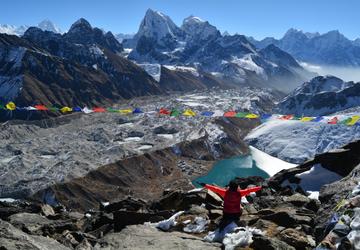
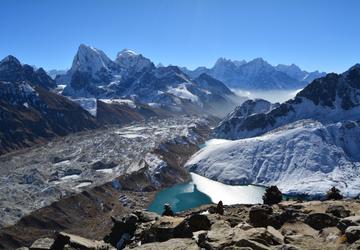
The summit of Gokyo Ri is famous for providing the best panoramas in the Himalayan range. So, reward yourself with the best expansive views of snowcapped 8000m mountains such as the world highest Mt. Everest 8,850m, fifth-highest Makalu 8,485m, fourth-highest Lhotse 8,516m, and sixth-highest Cho Oyu 8,201m, Lobuche, etc. along with glorious Mahalangur Himalayan range, largest Ngozumba glacier, and the five consecutive lakes stretch along the Gokyo valley. After taking in the amazing mountains of the Himalayas all day, we'll head back to Gokyo Village. If you have the energy, you can continue to the 4th or 5th lake Gokyo Lakes. All meals included.
Day 14
Trek to Dole (4,200 m/13776ft): 14km/5-6 hours
Today we descend down to Dole. As we are descending today, the air will start to feel more normal making the trek feel easier. The scenic track descends past the second and first Gokyo Lake and along the Dudh Koshi River. Behind you will see incredible views of both Cholatse and Cho Oyu peaks.
The trail then climbs again, offering views of Amadablam, Kantega, and Thamserku. We walk past the villages of Machermo and Luza villages and reach Dole early afternoon. All meals included.
Day 15
Dole to Namche Bazaar: 12 km/4-5hours
The day begins with a steep downhill toward Phortse Tenga. It takes approximately ONE and a half hours to reach Phortse Tenga from Dole. Then, the trail ascends steeply from Phortse Tenga up to the village of Mongla. Mongla is is a settlement on a hilltop with awesome mountain views. We walk through the greenery of rhododendron forests, waterfall, and the village of Kyangjuma before reaching the vibrant town of Namche Bazaar. All meals included.
Day 16
Namche Bazaar to Lukla. 20km/6-7 hours
Today we complete our trekking and congratulate ourselves as we successfully completed Everest Base Camp and the Gokyo loop back to Lukla! We'll trek back the same way we trekked up. It's a sad day as we leave the region behind, and leave Sagarmatha National Park, as well as we say goodbye to the rest of our trekking crew including our porters as we settle in for the night in Lukla.
Day 17
Fly Lukla to Kathmandu
Today we take our domestic flight back to Kathmandu from Lukla (included), and wave goodbye to the stunning Himalayas peaks. Upon landing, we get transferred to the hotel in Kathmandu. Stay overnight at your hotel in Kathmandu with breakfast and farewell dinner included as meals of the day. Only breakfast and dinner included today.
Day 18
Departure Day
Sadly our 18 Day Everest Base Camp and Gokyo Lakes trek comes to an end. Our office representative will assist you in transferring you to the International airport in Kathmandu 3 hours prior to your scheduled international flight. We hope to see you again soon in the near future and you give us another chance to organize adventurous trips in days to come.
Please Note: Note: You are suggested to come with an extra day (or 2) buffer days for all treks that need Kathmandu/Lukla/Kathmandu flights. Since Kathmandu/Lukla/Kathmandu flight is affected extremely by weather, sometimes even in months those are said to have good weather.
Delays are quite common, and cancellation also happens often. Extra days should always be scheduled at the end of the trip; this gives you flexibility with your trekking itinerary for any weather delays. More about Kathmandu/Lukla/Kathmandu flights
What's Included
Accommodation
4 Star Hotels (3 nights), Tea Houses and Lodges (14 Nights)
Meals
Breakfasts: 17, Lunches: 14, Dinners: 15
Vegetarian options are available on all meals throughout the adventure.
Vegetarian options availableLocal Guide
GuidedThis adventure is led by a local guide throughout. The main language of this adventure is English. Please contact us for other languages available.
Wifi
Wifi is available during the adventure. In some areas and / or accommodation / transport Wifi may be free.
Dates & Prices
Oct 2026
from £1,415Nov 2026
from £1,693Oct 2027
from £1,693Nov 2027
from £1,693
October 2026
3 departures- Save 24%Saturday 17 Oct 2026to Tuesday 3 Nov 20266+ spaces of 15 left£1,850£1,415Best offer
- Save 24%Saturday 24 Oct 2026to Tuesday 10 Nov 20266+ spaces of 15 left£1,850£1,415Best offer
- Save 24%Saturday 31 Oct 2026to Tuesday 17 Nov 20266+ spaces of 15 left£1,850£1,415Best offer
Make this tour private
Every departure on this trip can be booked just for your own group — your dates, your people, the same expert local guides.
What changes when you go private
Travel with just your own group
No other travellers on the trip — just the people you choose to bringTravel on your schedule
Pick your exact start date—no fixed group departures or rigid timetables.Exclusively for your party
Enjoy this handcrafted itinerary with a dedicated private guide just for you.
Customer reviews & ratings
As someone who has used a number of trekking companies in Nepal and other countries for similar trips, I couldn't be happier with my experiences with Icicles Adventure Treks and Tours in their Gokyo Lakes trekking package. Good points: 1. Organisation was excellent. Led by Indira back at base who emailed me in advance of the trip. Her emails were prompt, detailed and informative. I haven't had better service before being in country. 2. Our guide Gobinda was excellent on trek. His knowledge of the mountains was exceptional from years of work with Icicles. This hadn't dampened his enthusiasm for being in the mountains and this enthusiasm was infectious. Indeed it was really nice to see him still taking photos, even having been up to Gokyo about 50 times! His English was excellent and he gave accurate and informative overviews of the next day's trekking. He organised side activities like visiting monasteries. He was good fun in the evenings - sometimes eating with us and playing cards (although he needs to get better at the game 'cheat'!) 3. Our porter Tilak was equally excellent. It was lovely that he spent so much of the day with us and walking with Tilak and Gobinda was like being out in the hills with friends. They both answered questions about the mountains, Nepalese culture and more. For a porter, Tilak's English was very good and it is surely a matter of time before he becomes a guide! 4. Equipment. We borrowed some equipment having had things stolen in Papua New Guinea earlier in our trip. Sleeping bags were warm and clean. Down jackets were really cosy and were in good condition. We were given two large waterproof bags for our things which meant our own travelling rucksacks could stay in Kathmandu and avoid being bashed in travel. 5. Pre-trip meet up. We were met in out Thamel hotel by Indira the night before our trip. She brought everything we asked for and organised the remainder of our payment efficiently. It was great not to have to pop in to their store to sort this after a long flight. Overall I couldn't recommend Icicles highly enough. They were excellently run and good value for money. I would use them again in a heartbeat. Indeed I'm looking for dates to come back again already.
jmrileytoadhall Oct, 2022 VerifiedMyself and my daughter were due to trek to Gokyo Lakes & Gokyo Ri over these past 2weeks. Due to the weather conditions around Lukla Airport we were unable travel. After 2 Days of bad weather the manager- Indira Nepal suggested we look at an alternative. So it was decided we trek to Annapurna Base Camp. Within a couple of hours transfers and Hotels and permits were arranged by Indira and her team we enjoyed a trek to the base camp. The Trekking guide "Ramchandra" went out of his way to ensure our holiday was enjoyed daily and his knowledge and experience demonstrates the professionalism of this company. Icicles Adventure Trek and Tours went out of their way to make our experience in Nepal, one to remember. I would definitely use the company again if i revisited Nepal and recommend them to anyone looking to trek around the region.
Jim Milton Sep, 2022 Verified
Essential trip information
Our Important Notes and Packing List cover all essentials, from necessary equipment to inclusions, ensuring you're fully equipped and informed for this extraordinary adventure and more.
Frequently asked questions


Still have questions?
Can't find the answer you're looking for? Please chat to our friendly team.
Why book with us
Help Change The World
We collaborate with local businesses and communities.
Best Price Guaranteed
We won't be beaten on price. If you find this adventure at a lower price please get in touch!
You're In Good Hands
We work with trusted tour operators around the world.
You're spoilt for choice
We have the best choice of adventures on the market.