Kilimanjaro FAQs
Everything you need to know before you climb Kilimanjaro
Everything you need to know before you climb
At 5,895 metres, Mount Kilimanjaro is the highest mountain in Africa and the tallest free-standing mountain in the world. It's also one of the most achievable of the world's great summits. You don't need ropes or mountaineering experience to stand on Uhuru Peak, just good preparation, the right kit and a steady pace.
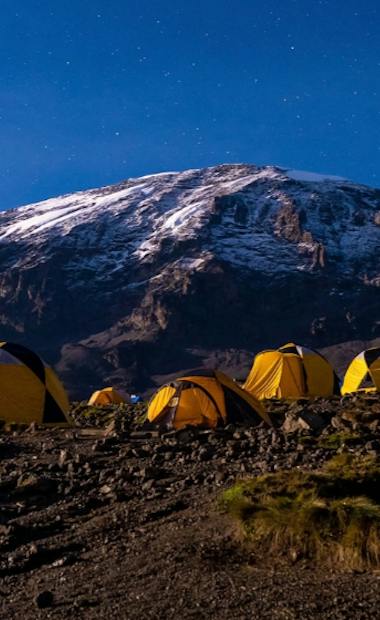
The climb takes you through five distinct climate zones, from farmland and rainforest to moorland, alpine desert and the glaciers of the summit crater. Along the way, a team of local guides, porters and cooks carry the camp, prepare your meals and keep a close eye on your health as you gain altitude.
We run our own Kilimanjaro climbs with experienced local guides, on routes including Marangu, Machame, Rongai and Lemosho. If you're thinking about taking on the Roof of Africa, this guide answers the questions we're asked most often, from how long it takes and what it costs to how fit you need to be and what to pack.
Where is Kilimanjaro?
Mount Kilimanjaro is in north-east Tanzania, close to the border with Kenya and around 330km south of the equator. It sits within Kilimanjaro National Park, a UNESCO World Heritage Site. The nearest towns are Moshi, where most climbs start and finish, and Arusha, around 80km to the west.
How high is Kilimanjaro?
Kilimanjaro's summit, Uhuru Peak, stands at 5,895 metres (19,341 feet) above sea level. It's the highest point in Africa and one of the Seven Summits, the highest peaks on each continent.
How long does it take to climb Kilimanjaro?
Most climbs spend between 5 and 8 days on the mountain, depending on the route. Our Kilimanjaro trips last 6 to 10 days in total, including nights in Moshi before and after the climb.
Longer itineraries take a little more time but give your body more chance to adjust to the altitude, which improves your chances of reaching the summit.
When is the best time to climb Kilimanjaro?
You can climb Kilimanjaro all year round. For the most reliable weather, go from late June to early October, or in January and February. These are the two dry seasons and the most popular times to climb.
If you'd prefer quieter trails, early March, June and November are good alternatives. For a full month-by-month breakdown, read our guide to the best time to climb Kilimanjaro.
Which are the wettest months on Kilimanjaro?
April and May are the wettest months, during the long rains, with April usually the wettest of all. The short rains in November and early December are lighter, often falling as afternoon showers.
The rainy months bring muddy forest trails and a higher chance of snow on the summit, but also far fewer climbers. See our best time to climb Kilimanjaro guide for more on each season.
How much does it cost to climb Kilimanjaro?
Our Kilimanjaro climbs start from around £1,400 per person for a 6-day Marangu route trip, rising to around £2,000 for a 10-day Lemosho trek. The price covers national park fees, which make up a large share of the cost, plus your guides, porters, cook, meals and camping equipment on the mountain, and hotel nights in Moshi.
On top of that, budget for international flights, your visa, travel insurance, tips for your mountain crew and any kit you need to buy or hire. You can spread the cost with monthly payments, or reserve your place now and pay later.
Where do you fly to for Kilimanjaro?
Fly into Kilimanjaro International Airport (JRO), which sits between Moshi and Arusha, about an hour's drive from Moshi. There are no direct flights from the UK, but you can connect through hubs such as Amsterdam, Doha, Istanbul, Addis Ababa or Nairobi.
We can also add flights to your booking, with ATOL protection and 24/7 support.
How do you get to Kilimanjaro?
Once you land at Kilimanjaro International Airport, it's a short drive to Moshi, the starting point for our climbs. Airport transfers are included on many of our Kilimanjaro trips, so check your trip details.
On your first evening you'll meet your guide for a briefing and kit check. The next morning, you'll drive to the park gate for your chosen route, which takes anywhere from under an hour to around four hours, depending on the route.
What are the different routes up Kilimanjaro?
There are seven main routes to the summit, each with its own scenery, gradient and number of days:
- Marangu: the oldest route, and the only one with huts instead of tents. You go up and down the same trail, usually over 5 to 6 days.
- Machame: a scenic and popular route through rainforest, moorland and alpine desert, including the Barranco Wall. Usually 6 to 7 days.
- Lemosho: starts on the quieter western side and crosses the Shira Plateau before joining the Machame route. Usually 7 to 8 days, with good acclimatisation.
- Rongai: the only route from the north, near the Kenyan border. Gentler and often drier, usually over 6 to 7 days.
- Northern Circuit: the longest route, circling the quiet northern slopes over 9 days or more.
- Umbwe: the steepest and most direct route, best suited to experienced trekkers.
- Shira: similar to Lemosho but starts higher up, so you gain altitude quickly at the start.
We run climbs on the Marangu, Machame, Rongai and Lemosho routes.
Which is the best Kilimanjaro route for beginners?
For first-time trekkers, the best route is usually the one that gives you the most time to acclimatise. A 7- or 8-day Machame, Rongai or Lemosho climb gives your body time to adjust and improves your chances of reaching the summit.
Marangu is often called the easiest route because of its huts and steady gradients. Its shorter itinerary means less time to acclimatise, though, so it isn't always the easiest way to the top.
How fit do you need to be to climb Kilimanjaro?
You don't need to be an athlete, but you do need a good level of stamina. Expect to walk for 4 to 7 hours a day for several days in a row, and for 10 to 14 hours on summit day.
The biggest challenge is the altitude rather than the walking itself, and fitness doesn't protect you from altitude sickness. Being fit means you'll recover better each evening and enjoy the climb more.
How should I train for Kilimanjaro?
Start training at least 12 weeks before your climb. The best preparation is hiking: long days on hilly trails, carrying a daypack and wearing the boots you'll take to Tanzania. Back-to-back hiking days in the final weeks are especially useful, as they prepare your legs for consecutive days on the mountain.
Add regular cardio, such as running, cycling or stair climbing, and leg and core strength work. For a week-by-week plan, read our training guide for Kilimanjaro's Lemosho route.
Can you climb Kilimanjaro solo or without a guide?
You can't climb Kilimanjaro without a guide. Kilimanjaro National Park rules require every climber to be accompanied by a licensed guide, and a support team of porters and a cook comes with every climb.
You can, however, travel solo and join a group. Across our trips, more than 60% of travellers join on their own, so you'll be in good company. Private climbs are also available if you'd prefer to go with just your own group.
What is the success rate of climbing Kilimanjaro?
Kilimanjaro National Park doesn't publish official summit statistics, so success rates quoted online are estimates. What is clear is that longer routes have higher success rates, because acclimatisation is the deciding factor.
Choosing an itinerary of 7 days or more, walking slowly and following your guide's advice give you the best chance of reaching the summit. Your guides monitor how you're coping with the altitude throughout the climb and will advise if you need to slow down or turn back.
How long does it take to descend Kilimanjaro?
Most climbers descend in around a day and a half. After reaching the summit, you walk back down to your high camp for a short rest, then continue to a lower camp at around 3,000 to 3,700 metres to sleep. The next morning, a 3- to 4-hour walk takes you to the park gate.
Summit day often involves more than 2,500 metres of descent, so trekking poles and strong legs make a big difference.
What should I pack for a Kilimanjaro climb?
You'll pass from warm rainforest to a summit where temperatures average around −7°C, so a layering system is key. The essentials include:
- Clothing: moisture-wicking base layers, a fleece, an insulated down jacket, a waterproof jacket and trousers, trekking trousers, a warm hat, a sun hat, a buff and two pairs of gloves (liners and insulated)
- Footwear: waterproof walking boots that are already broken in, plus comfortable shoes for camp and plenty of good trekking socks
- Sleeping: a sleeping bag rated to around −10°C or lower
- Daypack items: a 25–35 litre daypack with a rain cover, reusable water bottles or a bladder holding 3 litres, a head torch, sunglasses, high-factor sunscreen and snacks
- Health: a small first-aid kit, blister plasters, any personal medication, hand sanitiser and SPF lip balm
Porters carry your main bag between camps, usually up to 15kg, so you only carry your daypack. Single-use plastic bottles aren't allowed in the national park.
What equipment do I need to climb Kilimanjaro?
You don't need any technical climbing equipment. On our climbs, tents, sleeping mats, dining tents and cooking equipment are provided, and your crew carries and sets them up.
You'll need your own personal kit: clothing, boots, a sleeping bag, a daypack and a head torch. Trekking poles are strongly recommended, especially for the descent. If you don't want to buy everything, items such as sleeping bags, poles, gaiters and warm jackets can usually be hired in Moshi.
Do you need crampons for Kilimanjaro?
No, you don't normally need crampons. All the main routes are non-technical walking trails, and the summit path is mostly loose scree and rock rather than ice.
After heavy snowfall, usually in the rainy seasons, parts of the path near the crater rim can be icy. In these conditions your guide may recommend lightweight microspikes that slip over your boots, and will let you know before you set off.
Is Kilimanjaro safe?
For well-prepared climbers with an experienced team, Kilimanjaro is a safe mountain to climb. The routes are non-technical, and the main risk is altitude sickness, which can affect anyone regardless of age or fitness.
Mild symptoms such as headaches, nausea and poor sleep are common. Left untreated, altitude sickness can become serious, which is why a slow ascent, plenty of water and honesty with your guide about how you feel matter so much. On our Lemosho climbs, for example, guides hold wilderness first aid qualifications and carry emergency oxygen and pulse oximeters. You'll also need travel insurance that covers trekking to 6,000 metres, including emergency evacuation.
Do people die climbing Kilimanjaro?
Sadly, deaths do happen on Kilimanjaro, but they are rare. The national park doesn't publish official figures, but a study published in 2004 estimated around 14 deaths per 100,000 climbers, most of them linked to altitude illness.
The risk is highest for climbers who ascend too quickly or ignore symptoms. Choosing a longer route, going slowly and descending at the first sign of serious symptoms are the most effective ways to stay safe.
How old do you have to be to climb Kilimanjaro?
Kilimanjaro National Park allows children aged 10 and over to climb to the summit. Younger children need special permission to go above 3,100 metres, so they usually stick to day walks on the lower slopes.
On our climbs, the minimum age depends on the trip. Our 10-day Lemosho climb welcomes climbers from age 12, while most of our other Kilimanjaro trips are for travellers aged 18 and over. If you're planning a family climb, a private departure lets you set the pace for your group. There's no upper age limit, and people in their 70s and 80s have reached the summit.
Do you need a visa to climb Kilimanjaro?
Yes. UK citizens need a tourist visa to enter Tanzania. The FCDO advises applying for an e-visa before you travel, though single-entry visas are also available on arrival at the main airports.
Entry rules can change, so always check the latest FCDO entry requirements for Tanzania before you book your flights. If you're not a UK citizen, check with the Tanzanian embassy in your country.
What vaccinations do I need for Kilimanjaro?
Recommended vaccinations for Tanzania depend on your health, travel history and where else you're visiting. For the latest advice, see TravelHealthPro's vaccine recommendations for Tanzania.
Speak to your GP or a travel health clinic at least six to eight weeks before you travel. Ask them about malaria too, as it's present in much of Tanzania, including the area around Moshi. You may also need a yellow fever certificate if you're arriving from, or transiting through, a country with a risk of yellow fever.
Is climbing Kilimanjaro worth it?
For most people who climb it, yes. Standing on the highest point in Africa at sunrise, above the clouds and beside the summit glaciers, is a moment few forget. Few other mountains let you reach almost 6,000 metres without any technical climbing skills.
It isn't easy. Summit night is long, cold and tough. But the changing landscapes, the camaraderie of your group and the support of your mountain crew make it far more than a summit. Many climbers add a safari or a few days on Zanzibar afterwards to round off the trip. Browse our Kilimanjaro climbs to find the right one for you.

Still have questions?
Can't find the answer you're looking for? Please chat to our friendly team.