Everest Base Camp vs Kilimanjaro: which is harder?
How altitude, daily distances, terrain, summit day, sleep and accommodation compare

by The Adventure People on 3rd November 2026
Would you like to write for our blog? Please send an email to hello@theadventurepeople.com we'd love to hear your ideas!
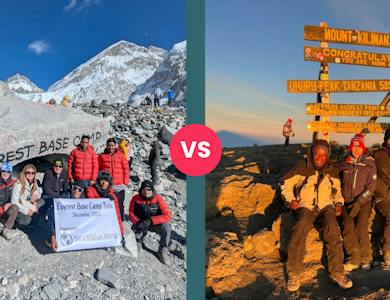
Everest Base Camp and Kilimanjaro are two of the world's most famous treks, and both take you above 5,000m without any technical climbing. But they're hard in very different ways.
The short answer: Kilimanjaro is harder in short, sharp bursts. You climb higher, faster, and summit night is the toughest single day on either trek. Everest Base Camp is harder in endurance: it's around twice as long, with more days of walking and more nights sleeping at high altitude.
Which one feels harder for you depends on how your body copes with altitude, how you handle a long, steep night, and whether you prefer a short, intense challenge or a long journey. This guide compares the two on altitude, daily distances, overall duration, terrain, summit day, accommodation and sleep, then looks at which to do first.
Everest Base Camp vs Kilimanjaro at a glance
Figures below are for typical itineraries: a 12-day round trip from Lukla for Everest Base Camp, and the 7- or 8-day Machame and Lemosho routes for Kilimanjaro.
Everest Base Camp | Kilimanjaro | |
|---|---|---|
Highest point | Kala Patthar, around 5,640m (base camp itself is 5,364m) | Uhuru Peak, 5,895m |
Starting altitude | Lukla, 2,860m | Park gate, around 1,800m |
Height gained to the top | Around 2,800m | Around 4,100m |
Days on the trail | Around 12 (8 up, 4 down) | 6 to 8 |
Total distance | Around 130km | Around 60–70km |
Typical day | 5–7 hours' walking | 4–7 hours' walking |
Hardest day | The day you reach base camp, then a dawn climb of Kala Patthar | Summit night: 12–15 hours, starting around midnight |
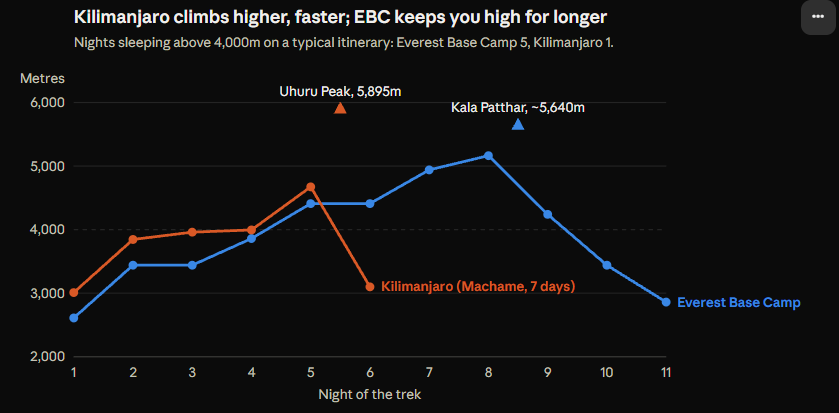
Nights above 4,000m | Around 5 | 1 |
Highest night's sleep | Gorak Shep, 5,164m | High camp, around 4,700m |
Accommodation | Teahouses (simple mountain lodges) | Tents (huts on the Marangu route) |
Terrain | Stone steps, suspension bridges, rocky glacial moraine | Forest trails, rocky paths, steep scree, a scramble on some routes |
Technical climbing | None | None |
Getting there | Short flight into Lukla, often delayed by weather | Drive to the park gate from Moshi or Arusha |
Showers | Hot showers at many lodges, usually for a small fee | None on the mountain |
Altitude and acclimatisation
Altitude is what makes both treks hard, far more than the walking itself. At the top of either, each breath holds only about half the oxygen it would at sea level, so even slow, steady steps leave you breathless.
Kilimanjaro is higher, and you get there faster. You start lower, at around 1,800m, and gain around 4,100m in under a week. That pace gives your body less time to adjust, which is why altitude sickness is a bigger risk on Kilimanjaro. Longer routes help: the 8-day Lemosho or Machame routes build in more time to acclimatise, and days that climb high then sleep lower, such as the walk via Lava Tower (4,630m) down to Barranco, help your body adapt.
Everest Base Camp is lower at the top, but you live at altitude for longer. The ascent is gradual, with rest days built in at Namche Bazaar and Dingboche, so most people acclimatise well. But you spend several nights above 4,000m, including one at Gorak Shep at 5,164m, and those nights take their toll on sleep, appetite and energy.
View our Everest Base Camp treks →
Fitness helps you enjoy either trek, but it doesn't protect you from altitude sickness. A slow pace, plenty of water and a well-designed itinerary make the biggest difference.
Daily distances and overall duration
Everest Base Camp is the longer journey. A typical trek covers around 130km over 12 days on the trail, plus time in Kathmandu either side. Most days involve 5 to 7 hours of walking, usually somewhere between 8km and 15km. The distances aren't huge, but the hours add up: by the time you're back in Lukla, you'll have walked for close to two weeks with only a couple of rest days.
Kilimanjaro is shorter but more concentrated. Depending on the route, you'll cover around 60km to 70km in 6 to 8 days. Most days are 4 to 7 hours of walking, often only 5km to 12km, at a deliberately slow pace. Then comes summit night, which can be the longest day you've ever walked (see below).
In short: EBC tests your stamina over many days, while Kilimanjaro saves most of its challenge for one huge push. If you find long trips tiring, EBC's length may feel harder. If you struggle with a single exhausting day, Kilimanjaro's summit night will be the bigger test.
It's also worth thinking about time off work. Everest Base Camp usually needs around two and a half weeks door to door, while Kilimanjaro fits into a week and a half or so.
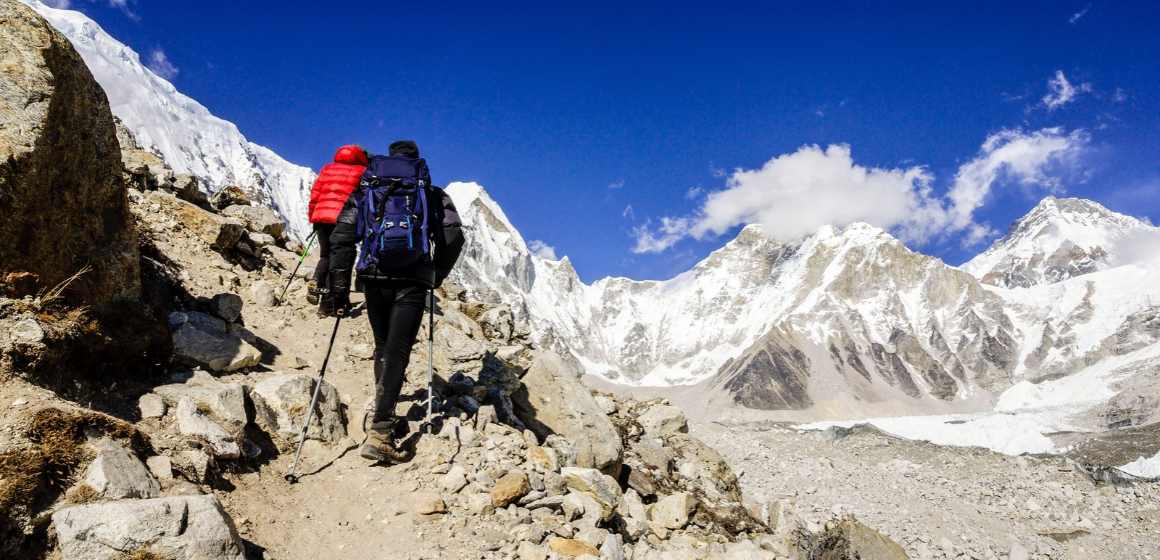 Khumbu Glacier along the Everest Base Camp trek in Nepal
Terrain
Everest Base Camp follows a well-trodden trail up the Khumbu valley. You'll climb long stone staircases, cross high suspension bridges over glacial rivers, and share the path with yaks and porters. The steep climb up to Namche Bazaar is one of the toughest sections early on. Beyond Lobuche, the trail turns rocky and uneven as it crosses the moraine beside the Khumbu Glacier, which is slow going at that altitude.
View our Everest Base Camp treks →
Kilimanjaro passes through a series of climate zones in a few days: muddy rainforest, open heath and moorland, then a stark, rocky alpine desert. On the Machame and Lemosho routes, the Barranco Wall involves a short scramble where you'll use your hands, though it's not technical. The steepest ground is saved for the top: loose scree and switchbacks on the final climb to the crater rim.
Neither trek needs ropes or climbing experience. Underfoot, EBC is more about endless ups and downs over many days, while Kilimanjaro is steeper, especially near the summit.
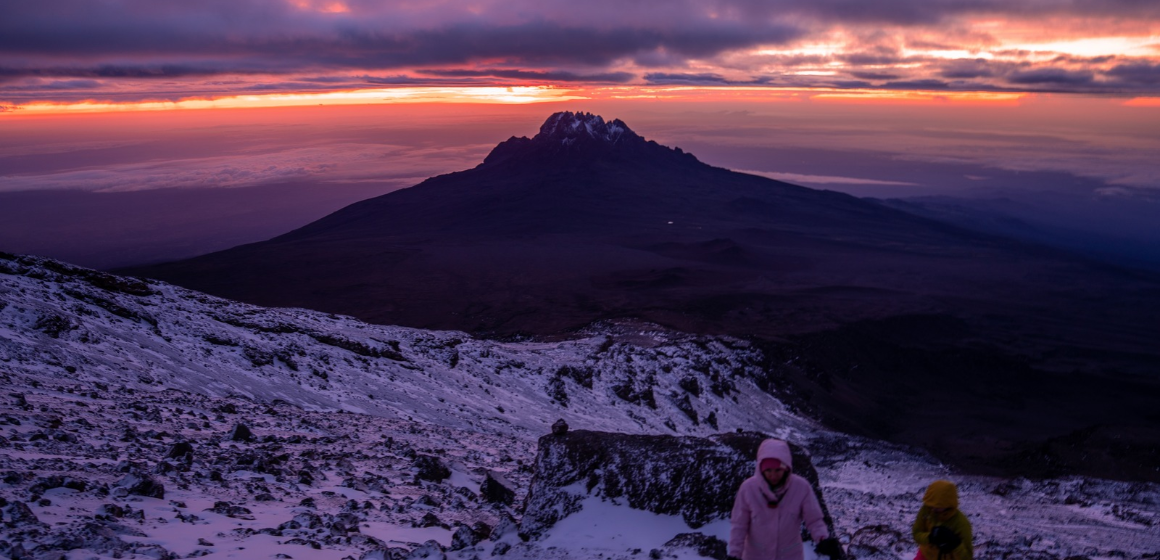 Sunrise at Uhuru Peak on Mount Kilimanjaro
Summit day
This is where the two treks differ most.
Kilimanjaro's summit night is the hardest day on either trek. You leave high camp at around 4,700m at midnight and climb about 1,200m in the dark and cold, on steep scree, to reach Uhuru Peak (5,895m) around sunrise. Then you descend around 2,000m or more to a lower camp. All in, it's typically 12 to 15 hours on your feet, much of it with temperatures well below freezing.
Everest Base Camp has no single summit push. The day you reach base camp is a long one: you walk from Lobuche to Gorak Shep, then on to base camp and back, usually 6 to 8 hours at over 5,000m. Most itineraries then add an optional pre-dawn climb up Kala Patthar the next morning, about 2 to 3 hours of steep walking for the best view of Everest, before starting the descent. It's tough, but it's spread over two days rather than packed into one night.
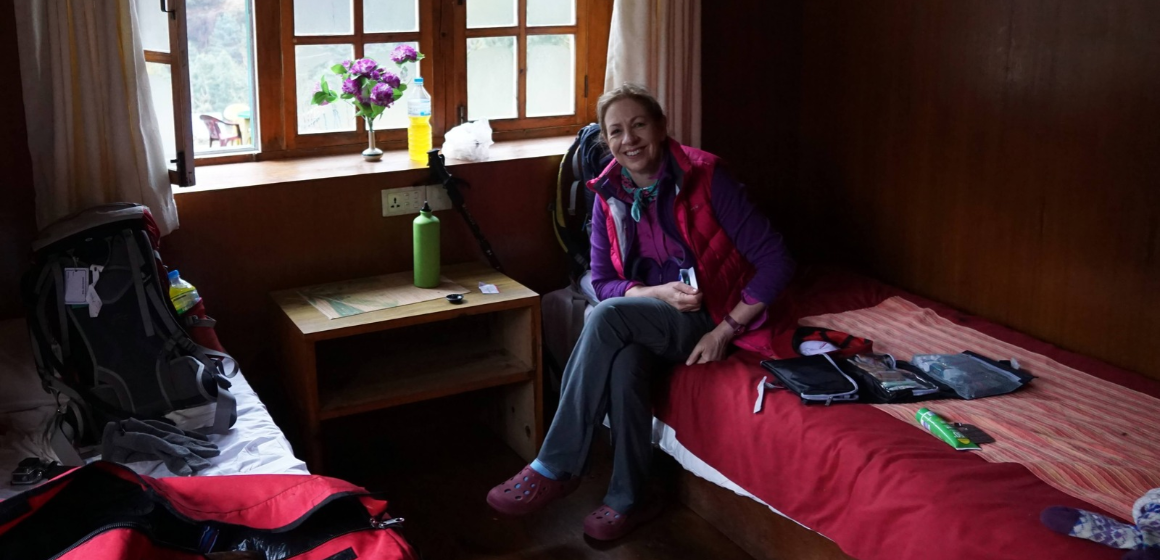 Accommodation at a teahouse along an early section of the EBC trek
Accommodation, sleep and energy
Where you'll sleep
Everest Base Camp: teahouses. Each night you stay in a simple mountain lodge. Rooms are usually twin bedrooms with thin walls and no heating, so you'll still need a warm sleeping bag. Evenings centre on the communal dining room, warmed by a stove, where you can eat hot meals from a menu, chat with other trekkers and dry your kit. Charging, Wi-Fi and hot showers are often available at an extra cost, though they get scarcer and pricier the higher you go.
View our Everest Base Camp treks →
Kilimanjaro: camping. On most routes you sleep in two-person tents, with a mess tent for meals cooked by your mountain crew. There are no showers, and you'll need a power bank for charging. Nights in a tent at altitude are cold, and getting comfortable on a sleeping mat takes some practice. The Marangu route is the exception, with dormitory-style huts.
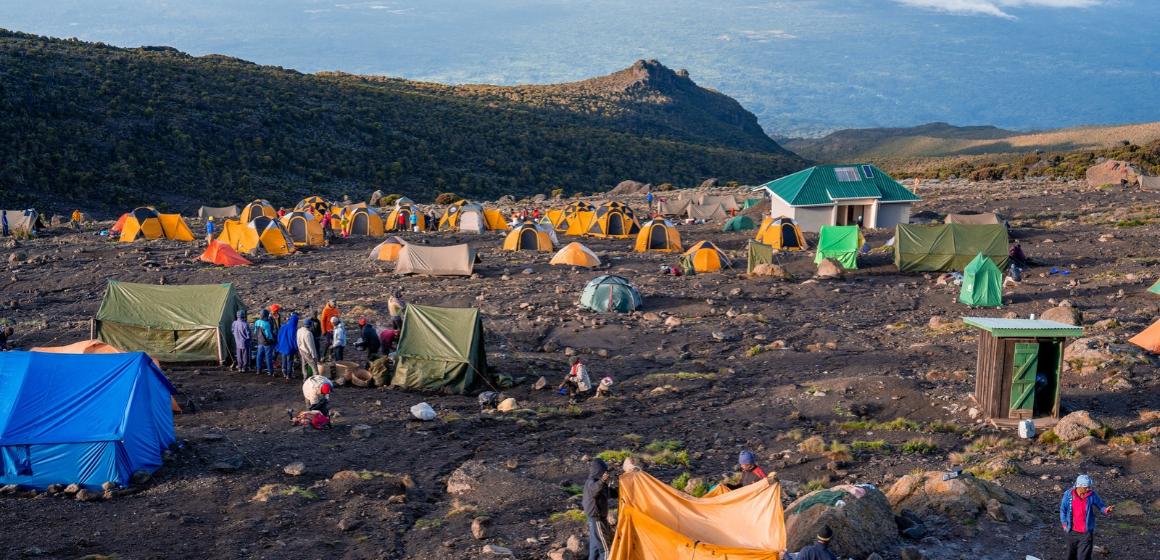 Camp ground with tents on Mount Kilimanjaro
How altitude affects your sleep
On both treks, sleep gets harder as you climb. Above around 3,000m, many people notice:
- Broken sleep and vivid dreams, often waking several times a night.
- Irregular breathing, where your breathing slows, pauses briefly, then speeds up again. It's a normal response to altitude, but it can wake you with a start.
- More trips to the toilet, as drinking plenty of water and your body's response to altitude both make you need to go more often.
- A smaller appetite, just when your body needs more fuel.
How this affects your energy
On Everest Base Camp, tiredness builds up. With around five nights above 4,000m, including one at 5,164m, poor sleep and a small appetite add up over the days. Many trekkers feel most drained around Lobuche and Gorak Shep, just as the trail gets hardest. The comforts of the lodges help: a warm dining room, a hot meal of your choice and the chance to dry your clothes make a real difference to recovery.
On Kilimanjaro, it's a shorter, sharper hit. You only spend about one night above 4,000m before summit night, but that night you get just a few hours' rest before a midnight start. You'll then be on your feet for most of the following day on almost no sleep. The overall trip is shorter, so there's less time for tiredness to build, but summit night will test your reserves.
Which should you do first?
There's no wrong order, and plenty of people do both. It depends on what you want to learn from your first big trek.
Do Everest Base Camp first if you're new to high altitude. Its slow, steady ascent and built-in rest days make it a gentler introduction. You'll find out how your body reacts to altitude, and get used to multi-day trekking, without the pressure of a fast climb. When you go on to Kilimanjaro, you'll know what altitude feels like and how to pace yourself on summit night.
View our Everest Base Camp treks →
Do Kilimanjaro first if time is tight or you want a big, concentrated challenge. It fits into a shorter holiday and gives you a real test of how you cope above 5,000m. If it goes well, EBC's longer journey will feel like the natural next step.
Either way, the second trek usually feels easier. Experience counts for a lot at altitude: knowing to go slowly, drink plenty, eat even when you're not hungry and recognise the early signs of altitude sickness.
How hard each trek feels if you've done other treks
If you've already done | Everest Base Camp will feel | Kilimanjaro will feel |
|---|---|---|
Kilimanjaro | Easier to handle at altitude, but longer: the challenge is stamina over two weeks | — |
Everest Base Camp | — | Shorter and more familiar at altitude, but summit night will still be the hardest day you've done |
The Inca Trail (high point 4,215m) | A big step up: more than twice as long, with several nights higher than you've slept before | A big step up in height: summit night goes almost 1,700m higher than Dead Woman's Pass |
Toubkal in Morocco (4,167m) | Familiar terrain, but far longer and higher | A good taste of the altitude, but summit night is much longer and higher |
Annapurna Base Camp (4,130m) | A natural next step: similar teahouse trekking, just higher and longer | Familiar in effort, but higher and faster, with camping instead of lodges |
Long-distance walks such as the Tour du Mont Blanc | Similar daily walking, but altitude makes everything slower and harder | Shorter days than you're used to, but altitude and summit night are a new challenge |
No multi-day treks | Achievable with training, but start preparing at least four to six months ahead | Achievable with training, ideally on a longer route such as the 8-day Lemosho |
Frequently asked questions
Is Kilimanjaro harder than Everest Base Camp?
For most people, Kilimanjaro's summit night is the hardest single day on either trek, and its faster ascent makes altitude sickness more likely. Everest Base Camp is harder on endurance, with nearly twice as many days walking and more nights at high altitude.
Which is higher, Everest Base Camp or Kilimanjaro?
Kilimanjaro. Uhuru Peak stands at 5,895m, while Everest Base Camp is at 5,364m. The highest point on most EBC treks is Kala Patthar, at around 5,640m.
Is altitude sickness more likely on Kilimanjaro or Everest Base Camp?
It's generally more likely on Kilimanjaro, because you climb higher in fewer days. Choosing a longer route, such as the 8-day Lemosho, gives your body more time to adjust.
Do I need climbing experience for either trek?
No. Both are non-technical treks that don't need ropes or climbing skills. What you need is good fitness, plenty of walking practice on hills, and a steady pace at altitude.
Which is better for a first high-altitude trek?
Everest Base Camp's gradual ascent makes it a gentler introduction to altitude. Kilimanjaro suits people with less time who want a bigger challenge in a shorter trip.
How long does each trek take?
Everest Base Camp usually takes around 12 days on the trail, or about two and a half weeks door to door. Kilimanjaro takes 6 to 8 days on the mountain, or around a week and a half door to door.