Carry Me Back: tackling waste on the Everest Base Camp trek
Local initiatives, trekker participation and tips on how to trek more sustainably

by The Adventure People on 15th October 2026
Would you like to write for our blog? Please send an email to hello@theadventurepeople.com we'd love to hear your ideas!
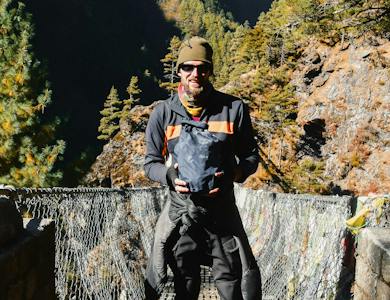
Trekking to Everest Base Camp is one of the great journeys of a lifetime. It also brings tens of thousands of people every year into a fragile, high-altitude valley with no roads, where every tin can and plastic wrapper has to be carried out by porter, yak or plane.
Waste in the Everest region is a real problem, and we don't think it should be brushed aside. In this article we look at the scale of the issue, what local organisations and the Nepali government are doing about it, and how our trekkers play a small but practical part through an initiative called Carry Me Back.
How big is the waste problem in the Everest region?
The Khumbu, the region of north-east Nepal that is home to Everest, welcomes between 60,000 and 100,000 people a year when visitors and porters are counted together. According to the Nepali Times, they generate thousands of tonnes of solid waste in an ecosystem already under pressure from climate change.
The challenge isn't only litter on the trail. For decades, the only practical option for much of the region's rubbish was to burn it or bury it. A survey by Sagarmatha Next and the Sagarmatha Pollution Control Committee mapped more than 70 landfill sites inside Sagarmatha National Park. With no road access, moving waste out of the valley for recycling is slow and expensive.
It's also worth separating two issues that are often blurred together. Much of the most widely shared imagery of rubbish on Everest comes from the climbing routes above Base Camp, where expedition waste can stay frozen in the ice above 6,000m. Trekkers to Base Camp don't go onto the mountain itself, but the lodges, villages and trails they pass through still produce waste that needs managing, and that is where trekkers can make a real difference.
What's already being done to manage waste
The Everest region has a longer history of tackling waste than many people realise, much of it led by the local Sherpa community.
The Sagarmatha Pollution Control Committee (SPCC). Set up in 1991, this local NGO manages waste across the region's trails, villages and base camps. It has built 125 bins along trekking trails and in schools, nine Environmental Stations where waste is collected and sorted (with 18 more planned), and a Material Recovery Facility in Namche Bazaar, with a second planned for Lukla.
A regional waste management plan. In 2020, Sagarmatha Next worked with researchers from the University of Colorado Boulder and Arizona State University to develop a solid waste management plan focused on recycling, reuse and reduction rather than burning and burying. The plan was peer reviewed and published in the journal Mountain Research and Development, and in 2023 the SPCC and the local municipality built its main strategies into the Sustainable Waste Management Plan of Khumbu.
A ban on single-use plastics. In 2019, Khumbu Pasang Lhamu Rural Municipality, which covers the Everest region, announced a ban on plastics under 30 microns thick and on drinks sold in plastic bottles, taking effect from January 2020.
Rules for climbers. Each Everest expedition pays a refundable US$4,000 garbage deposit, and since 2015 the SPCC has enforced a rule that every climber must bring 8kg of waste back down from above Base Camp. From the 2026 season, at least 2kg of that must come from Camp 2 or higher, and climbers must use SPCC-issued human waste bags.
Clean-up campaigns. The Nepal Army has run mountain clean-up campaigns in the Everest region since 2019, working with government ministries, the SPCC and the local municipality. The first campaign alone collected more than 10,000kg of waste from the Everest region.
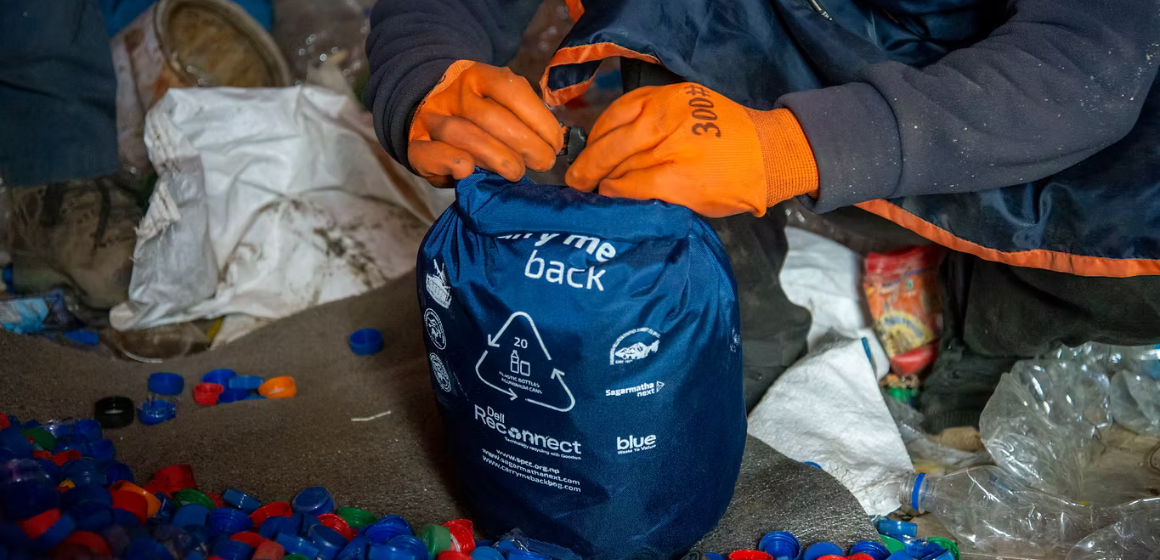 Image taken from the carrymebackbag.com website
What is Carry Me Back?
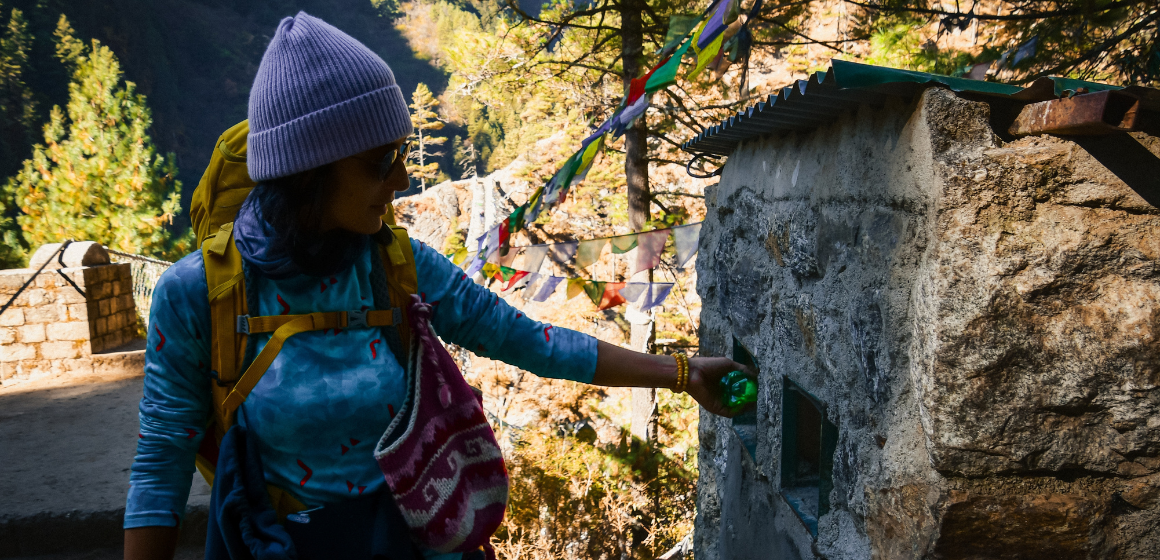
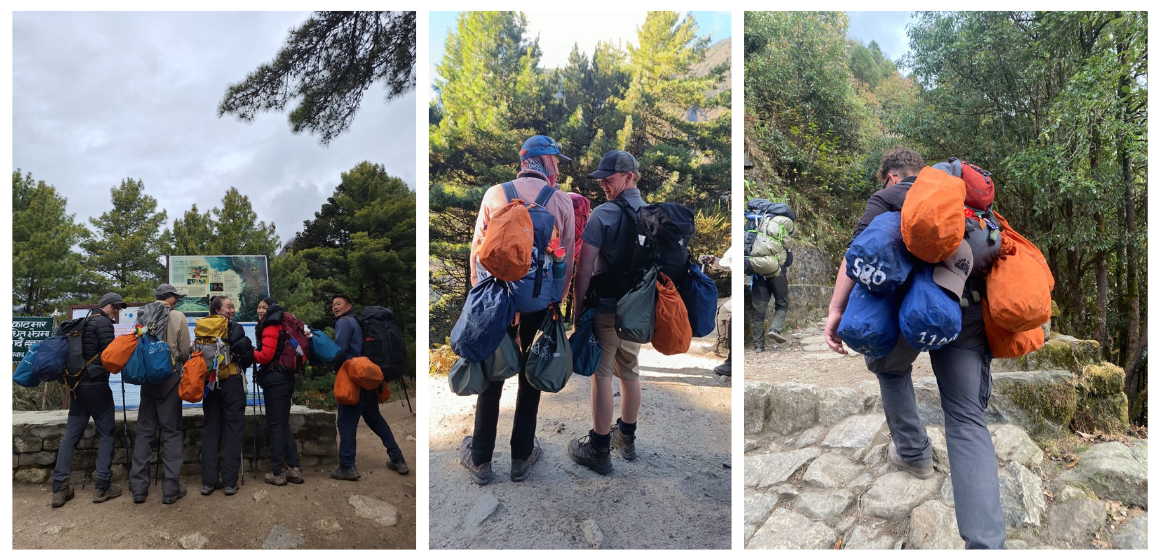
Carry Me Back is a crowdsourced waste removal scheme that asks trekkers to carry a 1kg bag of recyclable waste down the trail with them at the end of their trip. It was launched by Sagarmatha Next and the SPCC, and the idea is simple: thousands of people walk out of the Everest region every season, and each of them has room for a little extra weight.
How it works
- Waste is sorted and shredded locally. The SPCC separates recyclable waste, mainly plastic and aluminium, and shreds it to reduce its volume. It's then packed into Carry Me Back bags that hold about 1kg each.
- The bags themselves are upcycled. They were designed by the agency Super Local and are made by a women's group trained by moware, a local design workshop, using waste materials.
- Trekkers collect a bag on the way down. Bags are handed out at pick-up stations in Namche Bazaar and Pangboche as trekkers head back towards Lukla.
- Bags are dropped off at Lukla. Trekkers leave their bag in the dedicated bins at Lukla, where the trek ends.
- The waste is flown to Kathmandu and recycled. Tara Air transports the waste to Kathmandu, where the social enterprise Blue Waste to Value collects it for recycling.
 Image taken from the carrymebackbag.com website
The impact so far
The scheme began with a pilot in autumn 2019, when around 2,500 trekkers carried about 4,000kg of waste out of the region. After a pause during the pandemic, it restarted in 2022 and has grown almost every season since.
In autumn 2024, a record 6,098 trekkers took part and removed 8,267kg of waste. In autumn 2025, 5,293 participants carried out 7,250kg. Since spring 2025, everyone who takes part has been given a small coin made from recycled bottle caps, featuring Mount Everest.
According to a June 2026 report in the Nepali Times, more than 35,000 people have carried out over 45 tonnes of waste through the scheme over the past four years.
How our trekkers take part
We encourage everyone on our Everest Base Camp trek to carry a Carry Me Back bag on the final stretch of the trek. It's voluntary, it's free, and at around 1kg it adds very little to your daypack.
Our trek leaders explain the scheme during the trek and point out the pick-up stations as the group heads back down the valley. You simply collect a bag at Pangboche or Namche Bazaar, carry it with you to Lukla and drop it in the collection bins there before your flight back to Kathmandu. If you're feeling strong, there's nothing to stop you carrying more than one.
It's a small act, but it adds up. Every bag that leaves the valley is a bag of plastic or aluminium that goes to a recycling facility rather than a landfill pit, and it costs nothing more than a little space in your pack.
 Images taken from the @sagarmathanext Instagram account
Visiting Sagarmatha Next: where waste becomes art
On our Everest Base Camp trek, we also visit the Sagarmatha Next experience centre near Namche Bazaar. It's the organisation behind Carry Me Back, and its aim is to change how people think about waste.
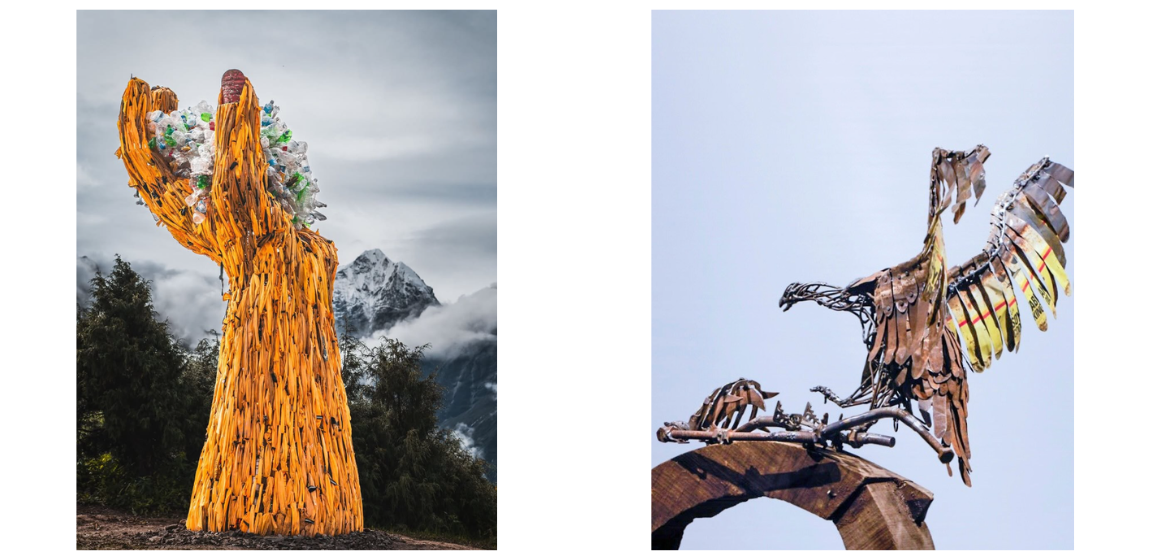
The centre includes a visitor and learning centre explaining the region's history and waste challenges, an art gallery, and a waste lab. Local and international artists work with materials collected from the trails. Recent pieces include sculptures of Himalayan vultures by Estonian artist Ines-Issa Villido and a 3D model of the Himalaya made from bottle caps collected on the trekking routes.
The centre also runs a shop selling products upcycled from waste by moware. Profits from donations, artwork and product sales support the SPCC's waste management work, so buying a souvenir here is a direct way to contribute. More than 75,000 people have visited since 2022.
Seeing the scheme up close, from the waste itself to what it can become, gives real context to the bag you'll carry down a few days later.
How to trek to Everest Base Camp more sustainably
Carrying a bag down is one way to help. These choices before and during your trek can reduce the waste you create in the first place.
- Bring reusable items and avoid single-use products. Pack a reusable water bottle, a reusable cup or mug, and a cloth bag for snacks or shopping. Every piece of single-use packaging you don't bring is one less item that has to be carried out of the valley.
- Purify your water instead of buying it bottled. Bring a filter bottle or purification tablets and refill as you go. Bottled water is still sold along the trail, and every empty bottle adds to the plastic waste the region has to manage.
- Pack zip-lock bags. Use them to carry snacks and to store any rubbish you create during the day until you reach a bin. They can be washed and reused when you get home.
- Repackage snacks before you leave home. Decant trail mix, energy bars and other snacks out of bulky outer packaging and into reusable bags or containers, so the packaging stays in your recycling at home.
- Take hard-to-process items home with you. Batteries, used wet wipes and other items that can't be recycled locally are best carried back to Kathmandu or home.
- Buy second-hand trekking gear. Make sustainable choices before you set off. Good-quality boots, jackets, poles and sleeping bags are widely available second-hand, and renting kit is another option for items you may only use once.
- Carry a Carry Me Back bag. Pick one up at Pangboche or Namche Bazaar on the way down and drop it off at Lukla. Carry two if you can.
- Support the local recycling economy. Upcycled souvenirs from the Sagarmatha Next shop help fund the SPCC's waste management work in the region.
Leaving the Khumbu better than we found it
Waste in the Everest region is a serious issue, and no single scheme will solve it. But the combination of local leadership from the SPCC, government regulation, regular clean-ups and community projects like Carry Me Back is making measurable progress. Trekkers are part of the problem, and they can be part of the solution too.
If you join us on the Everest Base Camp trek, we'll make it easy for you to take part. Pack light, pack reusable, and save a little room in your bag for the walk down.