The Five Stans of The Silk Road 2027 Reverse - 21 Days
Trip Snapshot
Age range
16 - 79Start / End
- Bishkek
- Ashgabat
Physical rating
Group size
1 - 16Meals included
30Highlights
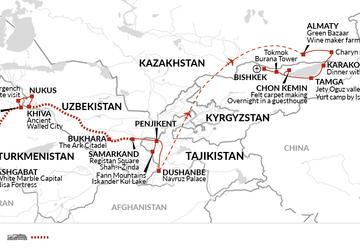
- An epic 3 week journey through the Silk Road highlights of the fabled Five Stans
- Walk amongst wild mountain scenery in the Fann Mountains
- Discover the ancient cities of Khiva, Bukhara and Samarkand
Download the full trip brochure
Everything you need to picture the adventure and pack with confidence — in one free PDF.
What's inside the PDF
Day-by-day itinerary
Every day mapped out, covering activities, travel times, meals and where you'll stay.Packing & kit list
Exactly what to bring, from clothing and essentials to luggage guidelines and what's available to hire locally.What's included
Accommodation, transport, guides and meals, so you can see exactly what your price covers.
Summary
Traverse mountains pocketed with turquoise alpine lakes, drive through lush fertile valleys and zip across dry and dusty desert plains by high-speed train. This is an all-encompassing, ever-changing journey through the 5 'Stans of Central Asia.
Fann Mountains - Walk amongst wild mountain scenery and snap the picture-perfect 'Seven Lakes'.
The Silk Road - Travel along ancient routes and discover the intricate architecture of Khiva, Bukhara and Samarkand.
Lake Issyk Kul - Sleep in a traditional yurt by the shores of 'The Pearl of Kyrgyzstan'
2027 - The tour will run reverse starting in Turkmenistan and ending in Kyrgyzstan
Itinerary
Day 1
Join trip in Ashgabat and have an afternoon exploring the city
Our tour starts today in Ashgabat, the capital of Turkmenistan. Once a prosperous frontier town along the Trans-Caspian railway, Ashgabat was destroyed by a massive earthquake in 1948, only to rise from the ashes and become the capital of an independent Turkmenistan in 1991. The city was the personal project of President Niyazov, who set about forming it in his own unique image, renaming the streets and changing the face of the city on an almost daily basis as he approved the destruction of its suburbs to make way for several controversial planning projects.
For those arriving on time today, our tour leader plans to meet you in the hotel reception at 11am for a welcome meeting, followed by a tour of the city. We'll head out to take in the highlights of both the Soviet and Niyazov reigns, visiting Independence Park where we'll see the Independence Monument, a large structure designed to resemble traditional Turkmen hats. We'll also pay a visit to the Turkmenistan National Museum of History, a rich cache of 150,000 objects and artefacts that date back to Neolithic times and the Bronze Age era of the Margiana civilisation.
If you'd like an airport transfer today, you'll need to arrive into Ashgabat International Airport (ASB), which is a 20-minute drive from the hotel. If you'd like to add additional days to your holiday pre-tour or arrange early check-in, please get in touch with us to book your accommodation.
Please note, if you plan to join the afternoon city tour today, you'll need to arrive at the hotel by 12pm. If you're booking your own flights, we recommend giving yourself at least one to two hours to clear the airport. From the airport to the hotel is around a 20-minute drive, therefore the latest your flight can arrive is 9am. If you miss the welcome meeting, our tour leader will inform you of any essential information at 6pm.
Day 2
In Ashgabat, visit Nisa Fortress and Gypjak Mosque. Overnight train to Dashoguz
This morning, we'll drive to the outskirts of the city to visit the once-mighty fortress of Nisa, a UNESCO World Heritage Site and the earliest of the Parthian Empire's capitals. Founded in the 3rd century BC as the capital of the first Parthian Empire, its walls and 43 towers once protected a royal palace, Zoroastrian temples, and the power and prestige of successive ruling dynasties, until its eventual destruction by the Mongols in the 13th century.
Set in an atmospheric location on an irregular pentagonal hill at the foot of the Kopet-Dag Mountains, Old Nisa is a striking landmark. Covering 14 hectares, the fortress contains two partially excavated Parthian-period complexes (3rd century BC to 3rd century AD), believed to have served as a royal residence and a temple complex.
We'll then continue to the impressive Gypjak Mosque, also known as the Spiritual Mosque. The largest mosque in Central Asia, it was completed in 2002 at a reported cost of $100 million and reflects much of the city's architectural style, with opulent white marble walls and gleaming golden domes. After some time to explore, we'll return to the city, where we'll visit the National Memorial Complex „ Halk Hakydasy„ which houses WWII and Earthquake memorials. We'll spend some time at the Memorial Complex and the rest of the afternoon is free.
We'll have an early dinner at a traditional Turkmen café before embarking on our overnight train journey. Train schedules are usually confirmed around three months before travel, so our tour leader will adjust the day's timings according to our evening departure.
Once onboard, our tour leader will allocate beds. We'll aim to keep the group together as much as possible, however, it may be necessary to share with other travellers, including passengers of a different gender, as we'll be travelling in four-berth cabins. The journey takes us through some of Turkmenistan's most breath-taking landscapes and offers an authentic and practical way to travel, although facilities on board are fairly basic.
Day 3
Visit Kunya Urgench ruins. Cross the border into Uzbekistan and head to Nukus
On arrival in Dashoguz, we'll have breakfast at a local café. Afterwards, we'll transfer to Kunya Urgench. We'll step into the pages of history as we explore the ruins of this once-great city, discovering the remains of mausoleums which, although not perfectly preserved, still exude a powerful, mystical charm. We'll also see the towering Kutlug Timur Minaret, reaching skywards as a symbol of the architectural mastery of its time. As we explore, we'll uncover the cultural significance of Kunya Urgench and the stories embedded in its ancient stones, offering a perfect preview of what we'll experience during our time in Uzbekistan.
It'll then be time to bid a fond farewell to Turkmenistan as we cross the border into Uzbekistan, our second 'stan\ . Our destination for the day is Nukus, less than an hour's drive from the border. Nukus is the capital of the autonomous Republic of Karakalpakstan, which covers much of north-west Uzbekistan and is known for its distinct culture, history and even its own language. Please be aware that the border crossing involves walking 1.5 kilometres/1 mile on dusty road with our luggage, so please pack accordingly.
Once a thriving region, the area was devastated by the Aral Sea disaster that began in the 1960s and 1970s. This environmental catastrophe destroyed the fertile delta, leaving it almost completely dried up as the sea retreated far to the north. By the end of the 1980s, the Aral Sea had shrunk to just 10 per cent of its original size. As a result, present-day Nukus is partially deserted, creating an atmosphere that some describe as being at the very edge of the world.
In the afternoon, we'll head to the outskirts of the city for a guided tour of the fascinating Mizdahkhan Necropolis, where we'll learn about the mysteries surrounding this remarkable site. Founded in the 4th century BC, Mizdahkhan is one of Karakalpakstan's oldest and holiest places and is believed, according to local legend, to be the burial site of Adam. One of the crumbling mausoleums is known as the Apocalypse Clock; legend has it that with every fallen brick, the end of the world draws closer - Muslim pilgrims often return a brick to the structure, just in case.
Later in the day, we'll return to Nukus for an overnight stay at a comfortable hotel. Tonight's dinner will be hosted by a local family of musicians, who will play traditional Karakalpak music while we enjoy the local specialties they have prepared. Our total driving time today will be around three hours.
Day 4
Explore the impressive Savitsky Museum in Nukus. Drive to Khiva in the afternoon
After breakfast, we'll head to the eclectic Savitsky Museum in Nukus. Hidden in this little-known city is what is widely regarded as one of the finest collections of Soviet art. The museum is even sometimes called the 'Louvre of the Steppe'. Here, we'll spend time appreciating the world's second-largest collection of Russian avant-garde art, carefully preserved by Igor Savitsky, a Russian artist and collector. During the Soviet era, many of these works were considered controversial, and Savitsky helped to keep them hidden from the watchful eyes of the KGB. The collection spans a wide range of styles, including paintings, sculptures, and applied arts, with a particular emphasis on the 20th-century avant-garde movement.
Next, we have a four-hour drive to the city of Khiva. Parts of the journey are on slightly bumpy roads, as some of the tarmac dates back to Soviet times. Along the way, we'll pass through the so-called Valley of 50 Kalas (fortresses), stopping to admire the mystical ruins from the Zoroastrian era. The ancient palace city remains of Toprak Kala are some of the wonders we see while in the valley.
The early history of the walled city of Khiva and its surrounding region is uncertain. By the time the Arabs arrived in the 8th century, Khiva was one of three important cities dominating the area. Its strategic location on a branch of the Silk Road made it a highly prized imperial asset, with the British and Russians vying for control during the 19th-century 'Great Game'. In 1873, Khiva fell to the Russians, as had Samarkand and Bukhara before it. Much of the city was restored in the 1970s as part of a Soviet conservation programme, turning it into an open-air museum of remarkable historical significance.
On arrival in Khiva, we'll check in to our hotel before exploring the old citadel. Finally, we'll ascend the city walls to enjoy a spectacular sunset, when the warm colours illuminate ancient Khiva, making the view truly unforgettable.
Our totally driving time today is around four hours.
Day 5
A full day wandering the narrow streets of the 'Open Air Museum' of Khiva
On this morning's walking tour, we'll feel as if we are stepping into a scene from Arabian Nights as we explore the majestic Old Citadel. This 12th-century fortress once dominated the city before the construction of palaces, harems, barracks, and mosques. It is well worth climbing the steps of the Dzhuma Minaret for a panoramic view of the maze of streets below.
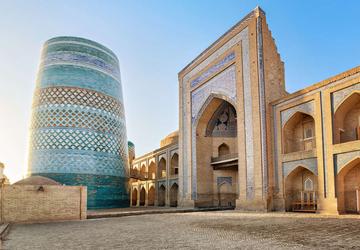
We'll then continue our exploration of Khiva's walled inner city, known as Ichan-Kala. This historic quarter contains more than 50 monuments alongside hundreds of centuries-old houses, all protected as a UNESCO World Heritage Site. As we pass through the enormous city gates, we'll be greeted by the gleaming splendour of the Kalta Minor, a striking example of Islamic design. Our tour will take us deep into the heart of Khiva, uncovering the richness of its architectural and cultural heritage, including mosques, tombs, and palaces - the Ichan-Kala fortress and the Kunya-Ark Palace will be two of the main highlights.
The rest of the afternoon is left free to explore at your own pace. You may choose to wander the streets a little further after dark, when moonlit silhouettes make the city even more magical. Alternatively, you could choose to visit Shukhov Tower and enjoy a view of Bukhara's ancient walls.
Day 6
Take a high-speed train to Bukhara
After breakfast, we'll wave Khiva goodbye and catch a high-speed train to Bukhara, our next destination.
The fabled city of Bukhara is more than 2,000 years old and is one of the most exceptionally preserved Islamic cities in Central Asia, considered by some to be the 'Bastion of Islam'. The town retains much of its Uzbek character and has more than 140 unique monuments.
On arrival, there will be some free time to go for a wander or have lunch at one of the many chaikhanas (tea houses), cafes and restaurants on the charming Lyabi Khause Square and complex - a tranquil pool once central to the city's water supply and shaded by mulberry trees. Our orientation tour will include both Divanbegi and Kukeldash Madrasahs which are both on Lyabi Khause Square and the 9th-century Magoki-Attari Mosque, the oldest mosque in Central Asia.
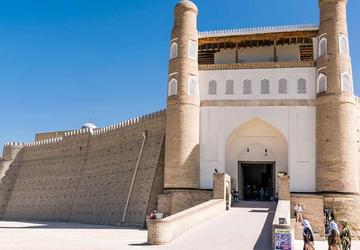
Later this afternoon, we meet up to wander through the narrow alleys of the old town and take a lift to the top of Shukhov Tower, where we enjoy a stunning bird's eye view of the city's outline. We then head to one of the most outstanding and iconic buildings in Bukhara; Kalyan Mosque and its towering minaret, which dates back to 1127 - one of the few buildings in the city to pre-date Genghis Khan's invasion.
To finish off the day, there'll be a chance to have dinner at a historic rooftop restaurant.
Day 7
City tour of Bukhara: discover blue-tiled domes and minarets
Bukhara was a key trading post on the Silk Road and has long been a centre of commerce, culture, and scholarship. Often called „ Bukhoroi Shareef„ or Holy Bukhara, this UNESCO-listed city is renowned for its hundreds of mosques and mausoleums, bustling bazaars, and labyrinthine streets. Over the centuries, various dynasties have competed for control, leaving behind a rich architectural and cultural heritage.
Today we'll spend the entire day exploring the atmospheric Old Town of Bukhara on foot, without driving outside the historic centre.
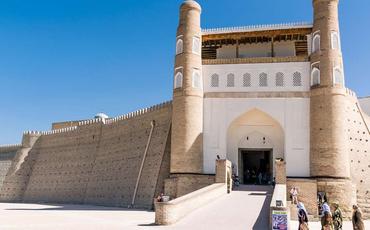
We'll be dropped off in the morning near the impressive Ark Fortress, once the residence of Bukhara's rulers. From here, we'll walk at a relaxed pace through the heart of the old town, stopping at its most significant landmarks along the way.
Our visits will include the beautifully preserved Samanid Mausoleum, one of Central Asia's oldest Islamic monuments, and the sacred Chashma-Ayub Mausoleum, linked to the legend of the prophet Job.
We'll then continue to the monumental Poi Kalon ensemble, where we'll see the iconic Kalyan Minaret \emdash the tallest monument in Bukhara, historically known as the 'tower of Death\ because prisoners were once executed from its heights \emdash alongside the grand Kalyan Mosque and the historic Miri-i-Arab Madrasah. As we make our way onwards, we'll stroll through the traditional trading domes, still lively with local crafts and souvenirs, and pass by the notable Abdulaziz Khan Madrasah.
By late morning we'll reach the charming Lyabi-Hauz Complex area, where we'll stop for lunch and some free time. You'll be able to relax by the pond, enjoy a café, or explore the surrounding lanes at your own pace.
After lunch, we'll take a short walk to the distinctive Chor Minor, famous for its four turquoise domes. We expect to finish the guided Old Town tour mid-afternoon.
Afterwards, there'll be free time to continue exploring independently, or for those who wish, we'll walk to the Old Jewish Quarter to visit the local synagogue.
Day 8
Free morning in Bukhara. Catch another high-speed train to Samarkand
This morning, you can choose to enjoy some free time in Bukhara or join a visit to a couple more nearby optional sights. We'll start with the Mausoleum of Naqshbandi, 15 kilometres/9 miles outside the city centre. This important Sufi site commemorates the influential Naqshbandiyya order and remains a place of pilgrimage. From here, we'll continue to the summer residence of the last Emir of Bukhara, Sitorai Mokhi Hossa \emdash Persian for „ the place where the moon meets the stars.„ We'll return to Bukhara for lunch.
Around mid-afternoon, we'll board the high-speed Afrosiyob train to Samarkand, covering 265 kilometres/164 miles in just 90 minutes. We'll arrive in Samarkand by early evening and check in to our centrally located hotel, where you'll have a few hours to relax, explore Alisher Naboi Central Park, or enjoy the hotel's outdoor pool.
Though Samarkand was once stormed by Alexander the Great and later devastated by Genghis Khan, it was transformed into the most magnificent city in Transoxiana by Amir Temur, who made it his capital in the 14th century. Even today, the monumental scale of its buildings continues to impress visitors. Sublime Samarkand was the heart of the Timurid Empire; Temur was one of history's greatest conquerors, ruling an empire that stretched across the Eurasian steppe. He governed with an iron fist, yet was a passionate patron of the arts and literature. Much of the architectural heritage from this period has survived, allowing us to imagine the city at the height of Temur's power.
In the evening, we'll begin exploring Samarkand with a visit to the majestic Gur-e-Amir Mausoleum, the final resting place of Amir Temur. We'll then head to the iconic Registan Square, where the magnificently patterned madrassahs are illuminated, creating a spectacle of light and architecture.
Day 9
Samarkand city tour
Today, we'll start our city tour with a visit to Bibi-Khanum Mosque, a structure that legend says was gifted to Timur by one of his wives. We'll also have some time to explore the Siyob Bazaar. After a break for lunch, we'll complete today's city tour with a visit to Gur-e-Amir, the gilded mausoleum where Timur is buried. We'll hear stories from his life and how he began the construction of Samarkand. This afternoon, we'll visit Registan Square, Samarkand's turquoise mosaic masterpiece. Registan's sweeping public square is flanked on three sides by huge intricately tiled madrasahs. Meticulously restored during Soviet times, it now echoes its former glory. We'll spend time taking in the scale of the monument, as well as learning about its role over the six centuries it's been standing.
The rest of the late afternoon and evening is free for you to explore Samarkand at your own pace. You may choose to tour the Koni Gil paper factory, or sample local wines from Samarkand at the Khovrenko Winery. In the evening, you might enjoy a folklore show at the El Merosi Costume Theatre or the Kohinur Plaza Hotel, or take a leisurely stroll through the Russian quarter to admire tsarist-era architecture and visit the local museum.
Day 10
Morning in Samarkand. Afternoon transfer to Penjikent. Visit Sarazm ruins in Tajikistan
After breakfast, we'll continue exploring the fairytale city of Samarkand. Our first stop is Shah-i-Zinda, a magnificent, tiled necropolis, followed by Ulugbek's Observatory, once the largest research centre in Central Asia. Ulugbek was decades ahead of the West in his observations of the solar system and the Earth, and we'll learn more about his remarkable achievements in this prestigious setting. We'll also visit the Afrasiyab Museum, which tells the story of ancient Samarkand \emdash then known as Afrasiyab \emdash a city that was destroyed by the Mongols in the early 13th century.
In the afternoon, we'll leave Uzbekistan and make our way into Tajikistan. We'll cross the border on foot and meet our local Tajik guide on the other side. Along the way, we'll visit the Sarazm ruins, a UNESCO World Heritage Site dating back over 5,000 years. These remarkable archaeological remains showcase one of the earliest known urban settlements in Central Asia, offering a fascinating glimpse into the lives of ancient communities in the region.
We'll arrive in Penjikent in the early evening. The accommodation for the night is a simple but comfortable hotel with twin rooms and en-suite bathrooms.
Day 11
Head into the Fanns Mountains and Iskander Kul Lake. Drive to Dushanbe
We'll set off early this morning for a scenic drive into the Fann Mountains, heading to Iskander Kul, a triangular alpine lake named after Alexander the Great. Often regarded as one of the most beautiful lakes in the former Soviet Union, it sits at an altitude of 2,200 metres/7,217 feet, surrounded by snow-capped peaks and rugged mountain scenery.
We'll enjoy lunch on the shores of the lake before taking a short walk to a nearby waterfall, soaking in the spectacular alpine surroundings. After our time at Iskander Kul, we'll continue our journey to Dushanbe, the capital of Tajikistan, aiming to arrive by early evening - just in time for dinner.
Dushanbe, Tajikistan's enigmatic capital, shares little history with the great Silk Road cities. For most of its past, it was a small village, only gaining prominence in the 20th century when Tajikistan became part of the USSR. The Soviets established Dushanbe as a centre for textile production, sparking the city's growth. More recently, it's undergone a decade-long building programme, transforming it into a modern city while retaining glimpses of its unique history.
Our total driving time for today is around seven hours.
Day 12
Dushanbe city tour
Originally, Dushanbe was a small village centred on a market held every Monday \emdash the Persian word Dushanbe means „ Monday,„ giving the city its name. It was during the Soviet era that Dushanbe grew into the industrial and administrative centre of Tajikistan, becoming the capital city it is today.
This morning we'll begin exploring the city's highlights starting with the National Museum of Antiquities, home to its famous 13-metre-long sleeping Buddha, rich archaeological collections, and fine art. From there, we'll visit the striking statue of Ismail Samani, a gold and marble monument commemorating the 1,100th anniversary of the Samanid State \emdash a Golden Age for the Tajik nation when science and the arts flourished.
Next, we'll walk to Rudaki Park, dedicated to the Persian poet Rudaki, who lived under the Samanids in the 9th and 10th centuries. We'll also visit the Navruz Palace, Dushanbe's gleaming centrepiece. Initially planned as the world's largest tea house, the palace was transformed when its interior frescoes and mosaic walls proved so impressive.
In contrast, we'll experience the intimate Museum of Musical Instruments, housed in a local home. Here, Iqbol Zavkibekov, son of the museum's founder Gurminj, will demonstrate a collection of around 100 traditional Pamiri and Tajik instruments, giving insight into how music is woven into the nomadic culture of Central Asia.
Day 13
Flight from Dushanbe to Almaty, Kazakhstan
Bidding goodbye to Tajikistan, we'll set off to Dushanbe's airport our short flight to Almaty in Kazakhstan. Please note that in order to secure your space on the internal group flight, we require your passport details at the time of booking.
Almaty ceded capital status to Astana in 1997, but it still remains the cultural and financial centre, where Russians, nomadic Kazakhs, Kyrgyz, Tartars and many other ethnic groups rub shoulders in its bustling markets. The city has an almost European feel, partly due to the earthquake in 1911 that flattened Almaty resulting in the complete re-planning and re-building of the city. Wide, leafy boulevards were constructed and lined with low-rise white-washed housing and offices, and the few period buildings that remained intact were restored to their former glory. The city enjoys an enviable position, nestled in the foothills of the Zailiysky Alatau range, with beautiful turquoise lakes, snow-capped mountains and chic ski resorts just a short drive away.
We'll check in into our hotel mid-afternoon - this will be our base for the next three nights. Later, our tour leader will give a short orientation tour of the city.
Day 14
Tour the wide boulevards and green parks of Almaty
Today we set out to explore some of the Almaty's major sites, starting in Panfilov Park. The park is diverse, serving as a popular meeting place for locals as well as housing a variety of important monuments and buildings. The park's focal point is the Ascension Cathedral, a beautiful Russian Orthodox cathedral. Also found in the park are imposing Soviet statues remembering falling soldiers from campaigns such as WW2 and the Afghan War, where many Kazakh nationals fought to support the USSR's interests.
We then move on to Green Market, a fascinating meeting place for the city's locals to come for their daily shopping. The market offers an eclectic range of produce brought by nomads as far-flung as Korea, all the way through China and Central Asia. Here you can find exotic fruits, and vegetables, an extensive butchery section with all types of meat and a wide variety of savoury foods. Make sure to try Kazy (smoked horse sausage) and Kurt (salted cheese balls popular with beer).
The rest of the afternoon has been left free to relax, or further exploration.
Day 15
Day trip to Issyk Lake and visit a wine maker farm
Today, we'll set off for a day trip to Issyk Lake, a stunning mountain lake in eastern Kazakhstan, not to be confused with the almost homonymous lake in Kyrgyzstan which we'll visit in a few days. Nestled in a broad valley and surrounded by rugged peaks, the lake is celebrated for its striking turquoise waters and dramatic natural scenery. Along the way, we'll pass through quaint villages, enjoying the changing landscapes of the Kazakh countryside.
On arrival we'll walk for about 20 minutes to the lakeshore and enjoy some time by the water breathing in the crisp mountain air and taking in the reflections of the surrounding peaks on the lake's surface. We'll uncover that this place wasn't always so serene \emdash the lake guards a tragic story from its past.
We return to the foothills of the mighty mountains, to the town of Esik. More than two millennia ago, the Saka tribes lived here, leaving behind not only settlements but, more importantly, their burial sites. In 1969, one of the burial mounds was scheduled to be cleared during construction work. It was believed to be empty, as the main chamber had been looted long before. However, during the excavation, archaeologists unexpectedly uncovered hundreds of gold artifacts hidden in a side chamber.This accidental discovery revealed what would become one of the most important symbols of modern Kazakhstan \emdash the Golden Man. Today, a historical reserve and a small museum stand here, telling the story of these mysterious ancient people and preserving the legacy they left behind. After visiting the museum and a short drive, we'll arrive at a winemaking farm \emdash a family-run vineyard known for producing high-quality homemade wines in the region. We'll walk through the vineyards and visit the cellars, learning about local winemaking traditions as well as the innovative techniques used to cultivate grapes in this unique terroir. But wine isn't the only specialty here. They also prepare incredible homemade mozzarella, which we'll taste with fresh local greens and as a key ingredient on delicious wood-fired pizzas. Feeling inspired? You'll even have the chance to make your own pizza \emdash and yes, everyone is welcome to join in. And of course, all of this will be perfectly complemented by Slava's wines. Today, you'll be nourishing both mind and body.
After a day of natural beauty and culinary discovery, we'll return to our hotel, arriving in the early evening with time to relax before dinner.
Our total driving time today will be around four hours.
Day 16
Walk inside Charyn Canyon then drive to Karakol
Today, we'll start early as we have a long day ahead, driving through the Kazakh steppe and into the Kyrgyz mountains. Our route takes us along the tip of the eastern Tien Shan range, crossing the border at Kegen before descending into the dry, dusty, and hot Kazakh steppe.
About halfway between Karakol and Almaty, we'll stop at Charyn Canyon, often compared to the Grand Canyon, albeit on a smaller scale. We'll visit the section known as the \ Valley of Castles\ for its unusual rock formations. From the rim, we'll descend 100 metres/328 feet to the river for a picnic, and those who wish can dip their feet in the cool water. The canyon stretches for 150 km in total, with the part we explore measuring 3 kilometres/1.8 miles long and 100 metres/328 feet deep. After two to three hours at the canyon, we'll continue our drive to the Kazakh-Kyrgyz border at Kegen.
After crossing the border on foot, we'll transfer through the Kyrgyz mountains to the town of Karakol. Nestled at the eastern tip of Lake Issyk Kul, Karakol is known for its charming wooden architecture, vibrant bazaars, and proximity to the alpine scenery of Tien Shan.
We'll check in at our hotel and enjoy dinner with a local Uighur family, experiencing traditional cuisine and warm hospitality.
Day 17
Explore the Jety Oguz valley and drive to Tamga for overnight in a yurt by Issyk Kul lake
Karakol was founded as a Russian military outpost in 1869 and grew in the 19th century as explorers mapped the peaks and valleys separating Kyrgyzstan from China. In the 1880s, the town's population surged with the arrival of Dungans \emdash Chinese Muslims fleeing warfare in China.
After breakfast, we'll tour the town's most interesting sights. Highlights include the Dungan Mosque, built in 1904, and the wooden Russian Orthodox Church, standing since 1869. We'll also visit the museum dedicated to the Russian explorer Przhevalsk and explore the town's vibrant local market.
In the afternoon, we'll journey to the Jety-Oguz valley, famous for its striking red rock formations and dramatic scenery. The name Jety-Oguz means „ Seven Bulls,„ inspired by the towering sandstone cliffs. We'll have time to walk among the formations and enjoy the alpine surroundings. During Soviet times this area became known as a health retreat, and the sanatorium remains. It became famous when after his first flight in space Yuri Gagarin came here to decompress.
Our day concludes in the village of Tamga, by Issyk Kul lake where we'll spend the night in a traditional yurt camp, experiencing authentic Kyrgyz hospitality under the stars. From Jety-Oguz, we'll wind our way to the iconic Lake Issyk Kul, quite rightly dubbed 'The Pearl of Kyrgyzstan'.
We arrive at our yurt camp, on the banks of Lake Issyk Kul in the late afternoon, where there will be time for swimming in the lake before dinner. Tonight's yurts will be twin-share with western-style toilets and cold showers available.
Our total driving time today will be around four hours.
Day 18
Visit felt carpets makers in Kyzyl Tuu and eagle hunters in Bokonbayevo. Drive to Chon Kemin
After breakfast, we'll leave the yurt camp and continue our journey along Issyk Kul lake. We trace our way alongside its southern shores to the village of Kyzyl Tuu, one of the centres for yurt production. Here we learn more about how these fascinating structures work and why they have been the chosen dwellings for Central Asian nomads for centuries.
Along our journey, we'll also have the chance to visit a local cooperative producing the two traditional types of Kyrgyz felt carpets, Ala-kiyiz and Shyrdaks and our final stop of today's journey is in Bokonbayevo where we meet an Eagle Hunter. Here we will see how this form of falconry has been practiced and perfected over centuries.
We arrive in Chon Kemin in the afternoon, where our home for the night is a quaint guesthouse in the middle of a peaceful valley, covered with green meadows that are full of wildflowers in spring and early summer, while forests of fir trees cloak the higher slopes.
Day 19
Boorsok bread making, then visit Burana Tower. Finally, drive to Bishkek
We'll spend the entire morning in the scenic Chon Kemin Valley. At breakfast, we'll embark on a masterclass to learn how to make Boorsok, the national bread and one of the country's staple foods. The doughy mixture is deep-fried in large quantities before being spread across the 'dastorkan' or table, doubling as a table decoration. Cooking an abundance of Boorsok is seen as a sign of generosity on the part of the host, so seldom will you see a dinner table not chock-full of tasty offerings.
We'll then depart for Bishkek, stopping en route at Burana Tower near the town of Tokmok. This 11th-century minaret is the only remaining structure of the ancient city of Balasagun, once the capital of the mighty Karakhanid Empire. We'll have the chance to climb the winding staircase of the tower for a wide view of the Chui Valley and explore the small open-air museum of balbals \emdash carved stone figures often found around ancient burial mounds.
Continuing to the nearby Tokmok stadium, we'll witness demonstrations of traditional Kyrgyz horse games. Highlights include Kok Boru, a form of polo played with a goat carcass, and Oodarysh, literally meaning „ wrestling from horseback.„ These games have remained hugely popular in the region for centuries, showcasing Kyrgyz horsemanship and culture.
From Tokmok, we'll drive approximately one and a half hours to Bishkek, our final stop on this epic journey and our base for the next two nights. Bishkek, a former Silk Road settlement. Kyrgyzstan's capital is a young city, starting life as a clay fort built by the Khan of Kokand in 1825, only to be destroyed by the Russians 43 years later and rebuilt in 1878.
We'll check in to our hotel and enjoy dinner at a local restaurant.
Our total driving time today is around four hours.
Day 20
Bishkek city tour
Bishkek is a city of wide boulevards and marble-faced public buildings, surrounded by numerous Soviet-style apartment blocks with leafy interior courtyards. Beyond the city centre, thousands of smaller privately built houses are scattered throughout. The streets follow a grid pattern, many flanked by narrow irrigation channels that water countless trees, providing welcome shade in the hot summers.
During our city tour, we'll explore Ala-Too Square, the heart of the city, and visit the newly renovated History Museum, where you will learn more about Kyrgyzstan's rich and fascinating past.
We'll then take a pleasant walk through Oak Park, leading us to its open-air gallery of sculptures that showcases both contemporary and traditional art in a relaxed setting. Along the way, we will also see the impressive Manas Statue and stroll along the Alley of Youth next to the Kyrgyz National Philharmonic Hall.
After the guided sightseeing, we'll have free time in the afternoon to explore the city on your own, enjoy shopping, or relax at one of Bishkek's cafés.
We'll conclude the day with an optional farewell dinner.
Day 21
Trip ends in Bishkek
The trip ends after breakfast at our hotel in Bishkek.
There are no activities planned today, so you're free to depart from Bishkek at any time. If your flight is departing later in the day, luggage storage facilities are available at our hotel. If you'd like an airport transfer today, you'll need to depart from Manas International Airport (BSZ), which is a 50-minute drive from the hotel.
What's Included
Accommodation
Comfortable
Meals
Breakfasts: 20, Lunches: 5, Dinners: 5
Vegetarian options are available on all meals throughout the adventure.
Vegetarian options availableLocal Guide
GuidedThis adventure is led by a local guide throughout. The main language of this adventure is English. Please contact us for other languages available.
Wifi
Wifi is available during the adventure. In some areas and / or accommodation / transport Wifi may be free.
Dates & Prices
Apr 2027
from £5,608May 2027
from £5,608Jun 2027
from £5,444Jul 2027
from £5,444Aug 2027
from £5,444Sep 2027
from £5,608Oct 2027
from £5,608
- Save 1%Monday 7 Jun 2027to Sunday 27 Jun 20276+ spaces of 16 left£5,499£5,444Pay MonthlyBest offerBook for£250 today, pay the rest later
Customer reviews & ratings
Uzbekistan was the highlight for me with its mosaic detail on the mausoleum and madrasah
Anonymous VerifiedThe trip was well planned & executed. A very thoughtful tour leader who made sure we were all 'on time' and totally informed of the days activities.
Ann Verified
Essential trip information
Our Important Notes and Packing List cover all essentials, from necessary equipment to inclusions, ensuring you're fully equipped and informed for this extraordinary adventure and more.



Still have questions?
Can't find the answer you're looking for? Please chat to our friendly team.
Why book with us
Help Change The World
We collaborate with local businesses and communities.
Best Price Guaranteed
We won't be beaten on price. If you find this adventure at a lower price please get in touch!
You're In Good Hands
We work with trusted tour operators around the world.
You're spoilt for choice
We have the best choice of adventures on the market.