Ancient Algeria and the Sahara Desert 2027 - 16 Days
Trip Snapshot
Age range
16 - 79Start / End
- Algiers
- Algiers
Physical rating
Group size
1 - 16Meals included
25Highlights
- Discover the Roman ruins of Djemila and Tipasa, both UNESCO World Heritage sites
- Venture into the Sahara Desert, stay in Ghardaia and explore the stunning M'Zab Valley
- Stroll around Constantine, the picturesque 'City of Bridges' and spend time in the capital, Algiers
Download the full trip brochure
Everything you need to picture the adventure and pack with confidence — in one free PDF.
What's inside the PDF
Day-by-day itinerary
Every day mapped out, covering activities, travel times, meals and where you'll stay.Packing & kit list
Exactly what to bring, from clothing and essentials to luggage guidelines and what's available to hire locally.What's included
Accommodation, transport, guides and meals, so you can see exactly what your price covers.
Summary
Our comprehensive two week Algeria tour takes you on a journey through Africa's largest country, from the Mediterranean coastline and stunning Islamic architecture of Algiers, the vibrant city of Constantine with its nearby ancient cities of Tipaza, Timgad and Dijemila to the breath-taking landscapes of the Algerian Sahara. Discover ancient rock paintings, witness mesmerizing sunsets over rolling sand dunes, and spend nights camping under a spectacular star-filled sky.
Roman ruins - Uncover the finest collection of Roman ruins in North Africa.
Desert rock art - Algeria has one of the richest collections of pre-historic rock art in the Tassili n'Ajjer plateau, remarkably well preserved in the arid desert environment.
Thriving cities - Soak up the atmosphere in Algiers and Constantine, enjoying great food and warm hospitality.
Digital detox - Switch off and embrace a slower pace (with no mobile signal) as we spend five nights wild camping in the desert with our crew.
Itinerary
Day 1
Join trip in Algiers
Our tour starts in the Algerian capital, Algiers. The country's largest city, Algiers today is a bustling Mediterranean port that can trace its origins back to Carthaginian traders of the 4th century BC. Dominated by the imposing walls of its citadel, the Kasbah quarter of the old town is a collection of meandering alleyways, palaces and mosques, that now fall under the protection of UNESCO. Away from the old town, the city's French colonial heritage embraces a collection of grand buildings and wide boulevards that sweep around the coastline.
There are no activities planned today, so you're free to arrive in Algiers at any time. On this tour we have limited time in the nations capital, you may wish to consider extending your trip. If you'd like an airport transfer today, you'll need to arrive into Algiers International Airport, also known as Houari Boumediene International Airport (ALG), which is around a 30-minute drive from the hotel depending on traffic. Due to the number of flights arriving later in the day, your tour leader will catch up with you the following morning for the welcome meeting.
Day 2
Visit the Roman sites of Tipaza and Cherchell on the Mediterranean coast. Evening flight to Ghardaia
After this morning's welcome briefing, we'll head west out of Algiers along the coast. Today we'll visit three sites along the Mediterranean coast. Our first stop is the massive, circular stone funerary monument of the Mausoleum of Mauritania, the final resting place of the last king and queen of Numidia. The views from the hilltop monument are impressive, with the fertile Mitidja plains stretching out beyond us. Historically, this area has been the agricultural heartland of the region.
Our next stop is Cherchell on the coast. The former capital of ancient Mauritania, today Cherchell has a busy fishing port. The town's museum houses a rare white marble copy of the Apollo of Phidias and a colossal statue of Augustus, as well as intricate mosaics depicting agricultural life and mythological scenes such as the Triumph of Dionysus. Just outside of the museum is the Place des Martyrs (Martyrs Square), a beautiful esplanade shaded by massive, centuries-old Phytolacca (Elephant) trees. It overlooks the harbour and serves as a lively meeting place for locals. You can spot Roman ruins scattered across the square, including ancient columns and capitals sitting amongst the modern benches.
We'll break for lunch in Tipaza, stopping at a local seafood restaurant (vegetarian options available) after lunch, it's a short ten-minute stroll to the archaeological park. Founded by the Carthaginians as a port and trading centre, the site contains a forum, four thermal baths and the outline of a large Christian Basilica. The setting is stunning, feeling like an open-air museum, situated between the mountains and the Mediterranean.
Arriving back in Algiers in the late afternoon, we'll head directly to Algiers airport for a flight to Ghardaia on the edge of the Sahara, the capital of the famous M'Zab Valley. Upon arrival, it's a short 20-minute drive to our hotel.
Day 3
Full day exploring Ghardaia and the settlements of Beni Isguen, Malika and El Ateuf in the M’Zab Valley
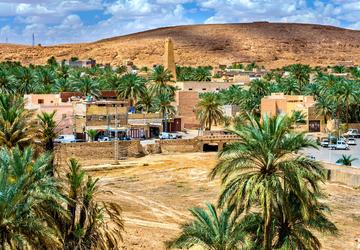
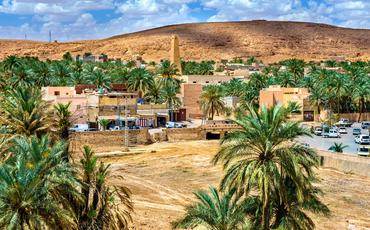
On the edge of the Sahara, Ghardaia is our gateway into the M'zab Valley. It's one of five ksours (hilltop towns) that were founded by members of the Muslim Ibadi sect nearly 1,000 years ago in 1053 AD. The town is distinctive thanks to its white, pink and red houses that are centred around its historic mosque.
We'll spend the day exploring the town and the neighbouring villages in the M'zab Valley. Starting on foot, we'll a visit the town's mosque, which we'll see from the outside, and walk around the lively markets and side streets with a local guide. This area gets very few tourists - it's an excellent place to purchase rugs and other fabrics at reasonable prices. Next we'll explore the outer lying sights by bus including Beni Yezguen, a sacred Berber Islamic town which prohibits all foreigners from spending the night within its walls, Malika and the scenic settlement of El Ateuf. We'll also see the date palm groves which thread between the settlements.
Ghardaia lies in the heart of the traditional homeland of the Mozabite people, a Berber tribe, most of whom are Ibadi Muslims, known for their warm hospitality.
We'll enjoy a home-cooked lunch at a traditional restaurant and the afternoon is free to rest or explore more of the town.
Day 4
Drive to M'sila
We have a long travel day ahead of us today as we head to M'sila - our total driving time will be around eight hours, though we'll make stops along the way. The scenery changes as we head back towards the fertile plains in the north of the country. Along the way, we'll pass through the town of Laghouat, the main settlement of the province sharing the same name. The town is centred around an oasis and is surrounded by the Amour Range. Further north, we'll pass Djelfa, aiming to arrive in M'sila around 6pm.
M'sila is a bustling provincial capital with a frontier atmosphere, being located at a crossroads between the arid desert plains to the south and a rugged mountain chain to the north. Our hotel is in the heart of the city within easy walking distance of several local restaurants.
Day 5
Visit Al Qal'a (fortress) of Beni Hammad and the vast Roman ruins at Timgad, overnight in Batna
Our first stop this morning is the Al Qal'a (fortress) of Beni Hammad - the fortress boasts a minaret (once part of the town's mosque) made from roughhewn sandstone blocks. Set amongst arid rolling hills, the area was inhabited by the first capital of the Hammadid empire in the 11th century. Its design influenced Arab architecture, which can be seen throughout the Maghreb, Andalucia, and as far away as Sicily. The site has a small museum, which we'll visit if it's open.
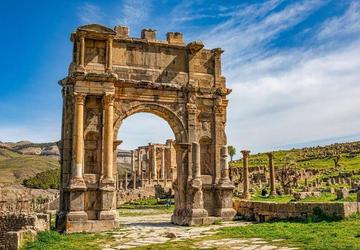
After lunch in Batna, we'll head to one of Algeria's archaeological crown jewels - Timgad. This old Roman city, known as the 'Pompeii of Africa, was built by Emperor Trajan as a reward for his troops.
Because the city was built on flat ground, its grid layout remains one of the best-preserved in the ancient world. We'll wander the main thoroughfares to discover the old forum, the thermal baths, and the imposing Triumphal Arch. Following a guided tour of the highlights, you'll have time to get lost in the maze of ancient streets at your own pace. Thanks to low visitor numbers, we often have the site virtually to ourselves. After our visit, we'll head back to Batna for the evening.
Please note during the winter months, when the days are shorter, we may visit Timgad in the morning of day six instead.
Day 6
Visit the tomb of Madghacen near Batna, continue to Constantine, the city of bridges
Our first stop today is the tomb of Madghacen, a royal mausoleum dating back to the era of the Berber Numidian Kings, located just outside Batna. This large cylindrical mausoleum dates to the 3rd century BC and is believed to be the tomb of a Numidian King.
After our short stop, we'll drive onwards to Constantine, perched above the Oued Rhumel River Valley. Constantine is also known as the 'City of Bridges' thanks to the seven bridges that span the ravine connecting the old city. Upon arrival in the city, we'll head to the Monument to the Dead, a memorial arch topped by a statue of the winged victory, commemorating the Algerian victims of World War I. Our vantage point up here lets us witness what a masterpiece of urban geography the city is. Walking downhill, we'll cross a suspension bridge (which hangs like a ribbon over the deep ravine) connecting the labyrinthine of the old city to the cliffs beyond. It's then a short walk along the busy Rue de Larbi Ben M'Hidi to our hotel in the city centre.
The rest of the afternoon is free. There's the option to take a trip to see the Roman ruins at Tiddis, occupied since the Neolithic period and containing several circular 'bazina' burial monuments from the pre-Roman Numidian times. See the budgeting and planning section for more details.
Constantine has some excellent restaurants, so this evening, we can head out to sample the local food.
Day 7
Full day to explore Constantine
Today we'll explore Constantine - both on foot and by bus - with our tour leader.
Founded over 2,000 years ago, the city (formerly known as Cirta) is built on a plateau surrounded by deep ravines. This site was chosen so the city could be easily defended but over the centuries, it's outgrown the plateau and spilled over.
Heading out on foot, we'll retrace our steps along the central Rue Larbi Ben M'Hidi, the main shopping street selling everything from clothing and shoes to electronics. Just off the central boulevard is one of the finest Ottoman structures in the city, the Palace of Ahmed Bey. We'll explore the palace's courtyards and gardens filled with palms and orange trees, and see the tiled mosaics. Just outside the palace is the 11th-century Great Mosque, the oldest mosque in the city, which we'll see from the outside.
Next, we'll walk through the alleyways of the casbah, along the Boulevard of the Abyss, overlooking the city's vast gorges, to the Sidi M'Cid suspension bridge - the city's most iconic symbol. The bridge measures 175 metres/575 feet in height and 168 metres/552 feet in length and connects the city to the hill. From the bridge, we'll get views over the old Bab El Kantara Bridge and the Sidi Rached Viaduct.
Our final stop is the National Museum of Cirta. The museum is a treasure trove of antiquities and relics found in Constantine and the surrounding areas, including the bronze sculpture of winged 'Victory of Constantine.'
Day 8
Explore the Roman ruins of Djemila, continue to Setif
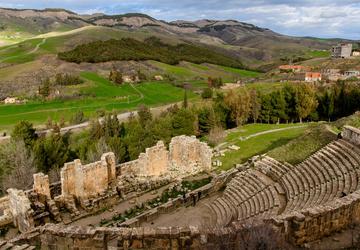
Located 125 kilometres/78 miles to the east of Constantine, the ancient village of Djemila is one of the most important and picturesque Roman remains in Algeria and one of the finest sites in North Africa.
Djemila sits on a hilltop, 900 metres/2,952 feet above sea level and is a fascinating example of the way Roman urbanism adapted to the sloping alpine terrain. Founded by the Emperor Nerva, the village was built to house his subjects. The streets are lined with the remains of houses, temples and a forum - we can also see the basilica and several triumphal arches. While in Djemila, we'll visit the museum, where every square inch of wall is plastered with intricate mosaics, making it one of the finest collections in the country.
After our visit, we'll have lunch and drive to Setif where we'll stay overnight (we might have a later lunch in Setif depending on timings). On arrival in the town, we'll visit the museum, which includes even more Roman mosaics. Our hotel in Setif is centrally located, close to a good selection of restaurants and shops.
Day 9
Return to Algiers; afternoon tour of the capital. Fly to Djanet deep in the Sahara
Today we'll head back Algiers (a journey of around four hours). On arrival, we'll have lunch at a local restaurant and then head out for an afternoon tour of the capital.
We'll start with a visit to the 92-meter/300-foot-tall Monument to the Martyrs, situated on a hill and overlooking the city. We'll then head to the Church of Notre Dame d'Afrique, which dominates the bay above Bab El Oued, before driving to the 10th-century city known as the Kasbah, or "The Citadelle". One of the most impressive old cities in North Africa, it has narrow cobbled streets, as well as palaces and mosques that date back to the Ottoman period - we'll explore on foot.
Finally, we'll visit one of Algier's most important historical monuments, Bastion 23 (or Palais des Rais). This Ottoman-era complex houses three palaces, and we'll have the chance to roam through secret rooms inside. Please note, the order of our visits might change depending on traffic conditions.
We'll be joined at this point by those travelling to just the south, we will also say goodbye to our tour leader, as we'll have a different tour leader in the south. Most flights to Djanet depart between 10pm and 11pm, we'll drive to the airport area and head out for dinner at a local restaurant then head to Algiers airport for the three hour flight to Djanet in the heart of the Sahara. Upon arrival (usually around 1 am) we will be met by our southern Algeria based team, it's a short twenty minute drive to our hotel located on the edge of town.
Day 10
Explore Djanet, drive out to explore the Timrass and Tekoubaouine region. First night comfortable camping in the desert
After a leisurely breakfast, we'll head into the desert town of Djanet. Sometimes described as the "Pearl of the Tassili" the town stands out with its emerald green palm groves tucked in amongst a moonscape of black rock and orange sand. We'll visit a local market where it's possible to get fitted out with a cheche ( multi-functional headwear worn by the Tuareg people), there'll also be time for souvenir shopping - the markets are known for quality silverware.
Leaving behind the relative civilization of Djanet we'll head out into the Sahara. We'll be traveling in a convoy of 4WD off-road vehicles, perfect for tackling the desert terrain. With a maximum of three people, plus a driver in each car, everyone gets a window seat. Driving one hour north of Djanet, we'll explore Timrass, a dramatic area of rocks protruding from the desert sand. Lunch is taken in the shade of a rock outcrop; our camp crew will set up tables and chairs and prepare a delicious salad accompanied by a hot main course option.
Continuing further into the desert, we'll witness some spectacular rock formations and see our first wonderfully preserved rock art paintings and engravings. Our local Tuareg guides will be on hand to provide interpretations of the paintings.
One of the magical parts of this trip is how remote our desert camps are - completely off the grid, in spectacular settings and with no one else around. After dropping our bags at the campsite, we'll head to a elevated spot to catch the sunset. After sunset, it's a short drive back to camp. Our first night in the desert is in a more comfortable fixed camp (akin to glamping) with spacious tents that have solar powered electrical outlets, lighting, a thick mattress, pillows and all linen provided. There's a separate seating area for dinner where tables and chairs are set up.
Our camping crew will prepare all of our meals in the desert. Our evening meal is three courses, consisting of soup to start with, followed by a main course of couscous, pasta or rice accompanied by vegetables and a meat-based dish (usually lamb stew or chicken) and bread cooked in the traditional Tuareg way, on hot coals under the sand. Dessert is seasonal fruit, followed by mint tea or coffee, dates and a cookie.
Day 11
Head into the northern limits of the Tenere, visit the crying cows engravings enroute
Our day starts around sunrise with a cup of tea or coffee followed by breakfast consisting of bread, butter, jams and cheese. After breakfast, we'll head off to visit the crying cows engravings, an elaborate ancient engraving depicting cattle. After a brief refuelling stop in Djanet we head southeast.
It doesn't take long to fall into the rhythm of desert travel, far from packed schedules and pressures of modern-day life, time matters less out here and with no distraction from mobile phones, we can focus on enjoying the natural beauty of one of the greatest wildernesses on earth. We'll pass through the most northern section, a massive, flat basin called the Tenere which stretches all the way into Niger and Chad. The name itself comes from the Tuareg word tinere, which literally translates to "desert" or "emptiness."
Our base for our second night is a semi-permanent camp at Ali Dema, consisting of a handful of stone huts built around a rock outcrop. There are several dramatic arch structures nearby and rock formations. There's time to head out for a short walk and find a good spot to watch the sun setting. After that, it's back to camp. Once the crew has pitched the tents, we'll get our first taste of Tuareg tea, also known as Maghrebi mint tea, relaxing around a campfire, followed by dinner, freshly cooked by our crew.
For our remaining nights in the desert, we'll stay in more basic dome tents, set up for either double, twin, or single use. Mattresses are provided but remember to bring a sleeping bag (see the equipment section for more details). There's also a communal dining area with rugs and tables, plus a toilet tent set up away from the main camp. Whilst more basic than the first fixed camp, this set up allows us to venture into parts of the desert few tourists get to see. Tonight, it's also possible to sleep in the basic stone huts, using the mattresses.
Day 12
Drive into the El Biredj canyon, heading deeper into the Sahara desert. Overnight in El Biredj
We'll witness some of the most spectacular desert scenery over the course of today. The first part of the journey is relatively flat. As we continue, low rocky hills will come into view, eventually we'll enter Oued El Biredj, a wide canyon-like valley, opening out to the vast landscape of the Tardart with its 'rock forests' of eroded sandstone pillars and numerous well preserved prehistoric rock art which we'll make stops to see along the way. The vistas get better and better as we venture further into the canyon.
After breaking for lunch in a shaded spot, we turn off from the main El Biredj canyon at which point we witness the most dramatic and beautiful sand dunes on the trip.
Our camping spot for tonight is in a remote area with breath taking views overlooking a distinctive twin rock tower against the backdrop of the vast sand dunes. There's time to head out for a walk to explore our surroundings and climb the dunes whilst the campsite is set up. The sharpness and shades of the dunes make this a classic desert landscape - a photographer's dream.
Day 13
Visit the striking El Biredj and Djaren Canyons and see desert rock art around Tin Koukak
There is an optional one-hour walk this morning. We'll set off early to avoid the heat of the day (4WD vehicles will be available for those who don't wish to walk).
Retracing our steps, we continue our journey deeper in the Tassili n'Ajjer plateau, eventually we reach the end of the El Biredj canyon where the high orange-coloured sand dunes of Moul El Naga begin to appear, the transition into the Djaren canyon involves an exciting steep descent down a sand dune. The valley floor opens up once again, as we drive through spectacular wind-sculptured arches (where we'll have our lunch). This area hosts one of the highest concentrations of rock art paintings in this part of Algeria, with over 70 locations exhibiting paintings and engravings found to date; we'll visit the best selection.
We'll camp in the wild once again, choosing a sheltered location next to one of the rock arches in the Djaren canyon.
Day 14
Full day in Djaren Canyon
After breakfast our camp crew will pack up camp, and we'll head out for our last full day in the desert. There's less driving today, giving us plenty of time to discover more rock art and if we're lucky, even spot wild camels and gazelles. Our camp tonight is at Tin Koukak in the atmospheric Djaren canyon. The sunsets here are spectacular and we'll witness some of the clearest night skies imaginable.
We'll set up camp and find a spot for sunset amongst the dunes, hills and rock formations, for our last night in the desert.
Day 15
Return to Djanet. Free afternoon
Our final morning in the desert. After a morning walk, we'll start our long drive back towards Djanet, we'll make stops along the way to take in the picturesque scenery. The first 30 kilometres is off-road, we'll then re-join the paved highway for the 120 kilometre/75 mile drive back to Djanet, arriving back to the Tentere Village Hotel where we'll get reacquainted with modern life. Day-use rooms will be provided to have a shower, the hotel also has WiFi at reception to catch up with messages from home.
The rest of the afternoon is free - you might like to head into Djanet itself or rest at the hotel. This evening, there is the opportunity to join the group for dinner at a local restaurant or at the hotel to celebrate our last night together.
We'll drive to Djanet airport, departing around 11pm for our night flight back to Algiers.
Day 16
Fly back to Algiers where the trip ends
Our flight back to Algiers departs in the early hours of the morning, arriving around 6am. The flight timing is subject to change and at the time of writing, this flight has a short, scheduled stop at Tamanrasset, although some flights are direct, landing at 4am.
Our trip ends upon arrival at Algiers International Airport, also known as Houari Boumediene International Airport (ALG). We recommend booking onward flights departing from 10am onwards in case of delays. If your flight departs later in the day, you may wish to walk over to the Hyatt Regency Algiers Airport Hotel located ten minutes away via an elevated walkway from the terminal building, the hotel offers a comprehensive buffet breakfast for around £15 / $20 USD starting at 6am. This is the closest hotel to the airport, should you wish to book a day use room, contact the hotel directly.
What's Included
Accommodation
Comfortable
Meals
Breakfasts: 14, Lunches: 6, Dinners: 5
Vegetarian options are available on all meals throughout the adventure.
Vegetarian options availableLocal Guide
GuidedThis adventure is led by a local guide throughout. The main language of this adventure is English. Please contact us for other languages available.
Wifi
Wifi is available during the adventure. In some areas and / or accommodation / transport Wifi may be free.
Dates & Prices
Jan 2027
from £3,802Mar 2027
from £3,802Oct 2027
from £3,802Nov 2027
from £3,802
- Save 1%Sunday 24 Jan 2027to Monday 8 Feb 20276+ spaces of 16 left£3,840£3,802Pay MonthlyBest offerBook for£250 today, pay the rest later
Essential trip information
Our Important Notes and Packing List cover all essentials, from necessary equipment to inclusions, ensuring you're fully equipped and informed for this extraordinary adventure and more.



Still have questions?
Can't find the answer you're looking for? Please chat to our friendly team.
Why book with us
Help Change The World
We collaborate with local businesses and communities.
Best Price Guaranteed
We won't be beaten on price. If you find this adventure at a lower price please get in touch!
You're In Good Hands
We work with trusted tour operators around the world.
You're spoilt for choice
We have the best choice of adventures on the market.